
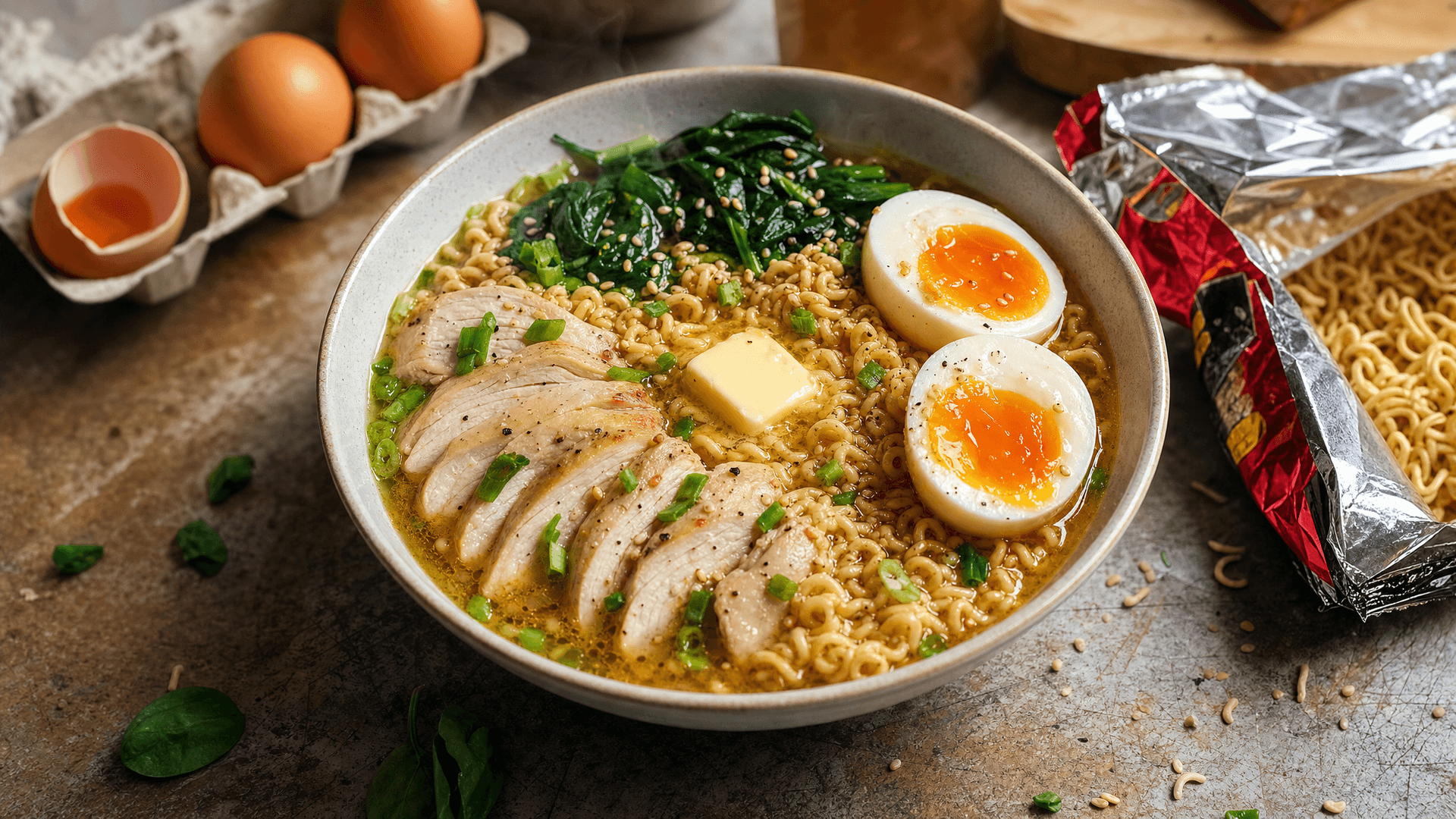
You've got a stack of them in the cupboard right now. Twelve packets, maybe twenty, bought because they were 30 cents each and you're not made of money.
And every time you eat one you feel exactly the same as before: still hungry, still skinny, still nowhere near your calorie target.
That's not a willpower problem. That's a math problem. A plain packet of instant ramen is roughly 380 calories and 8g of protein. That's a snack wearing a meal's costume. If you're trying to eat 3,500 calories a day, you'd need nine of them — and you'd still be short on protein by about 60g.
But here's the thing nobody tells broke lifters: the noodle brick isn't the problem. It's the base. It's a cheap, shelf-stable, salty, fast-cooking carb platform that costs almost nothing and accepts basically any ingredient you throw at it. Loaded properly, one packet becomes a 700-1,100 calorie, 40g+ protein meal for about $2 total — cooked in one pot, in a dorm kitchen, in nine minutes.
This is, calorie-for-dollar, the cheapest legitimate bulking meal that exists. Let's build it.
- A plain ramen packet is ~380 calories and 8g protein — a snack, not a meal
- The noodle brick is a base, not a meal; it costs 30 cents and accepts anything
- The formula: noodles + protein + fat + volume + flavor = 700-1,100 calories
- Two eggs, a spoon of peanut butter and a pat of butter alone add ~350 calories
- The high sodium is an advantage for hardgainers who train hard and sweat
- Frozen edamame, rotisserie chicken and milk powder are the best cost-per-gram add-ins
- One pot, under 10 minutes, roughly $2 a bowl
What's Actually In the Packet
Before you can fix it, you need to know what you're starting with. Here's a standard 3 oz packet — the classic square brick with the foil seasoning sachet.
| Nutrient | Amount | % of a 3,500 cal day |
|---|---|---|
| Calories | 380 | 11% |
| Protein | 8g | 4% |
| Carbs | 52g | — |
| Fat | 14g | — |
| Sodium | 1,700mg | — |
Two things jump out.
One: the protein is pathetic. 8g from a 380-calorie meal is a terrible ratio. You're getting mostly refined wheat flour and palm oil. For comparison, two eggs give you 12g of protein for 140 calories.
Two: the fat is already there. Most instant noodle bricks are flash-fried in palm oil before they're dried — that's where 14g of the fat comes from, and that's why they cook in three minutes. This is actually good news for a hardgainer. You're starting with a calorie-dense carb, not a bowl of steamed rice.
So the packet gives you a decent carb-and-fat base and almost no protein. That tells you exactly what to add.
The refined carb thing
Someone's going to tell you instant noodles are "empty calories" and refined carbs are bad. For a guy trying to gain weight, refined carbs are a feature. They're low in fiber, easy to digest, and they don't fill you up the way brown rice or oats do.
If you're a hardgainer, your enemy is fullness. Anything that gets calories into you without making you feel like you swallowed a brick is on your side. Save the whole grains for when you're cutting.
Why the Sodium Is a Feature, Not a Bug
The number everybody panics about: 1,700mg of sodium per packet, sometimes 1,900mg.
Here's the context nobody gives you. If you're a young guy who lifts four or five times a week, sweats through a shirt every session, and isn't dealing with high blood pressure, sodium is not your enemy. It's a performance input.
Sodium does three things that matter for a lifter:
- Pulls water into muscle cells. Sodium is a key driver of cell volumization. More intracellular water means better-looking, better-performing muscle.
- Replaces what you sweat out. A hard training session can cost you 1-2 liters of sweat, and sweat runs around 1,000mg of sodium per liter. You're not eating too much salt — you're replacing it.
- Drives thirst, which drives appetite. Salty food makes you want to keep eating. When you're force-feeding to hit 3,500 calories, that's a tool.
This applies to healthy young lifters with normal blood pressure. If you have hypertension, kidney issues, or a doctor has told you to limit salt, ignore all of this and use half the seasoning packet. Your health beats your bulk every single time.
The practical move: use the full seasoning packet if you trained that day, half if you didn't. And if you're sweating buckets in summer training, the packet is doing you a favor.
Don't drain the broth. Most of the sodium and a chunk of the flavor lives in that liquid, and drinking it makes the whole bowl go down easier. Slurping calories beats chewing them.
The Build-Your-Own Formula
Every upgraded bowl follows the same five-part structure. Learn the structure and you never need a recipe again.
Noodles + Protein + Fat + Volume + Flavor
| Layer | What it does | Cheap options |
|---|---|---|
| Noodles | 380 cal base | The packet you already own |
| Protein | Gets you to 40g+ | Eggs, rotisserie chicken, canned tuna, edamame, milk powder |
| Fat | Cheapest calorie density | Butter, peanut butter, sesame oil, cheese |
| Volume | Nutrients, makes it a real meal | Frozen veg, spinach, scallions, mushrooms |
| Flavor | Makes it repeatable | Soy sauce, sriracha, chili crisp, garlic, lime |
Miss the protein layer and you've got a fatty carb bomb. Miss the fat layer and you're stuck around 550 calories. Miss the volume layer and you'll get sick of it inside two weeks — which is the actual reason most bulking plans fail.
The cost-per-calorie table
Here's what each add-in actually costs and delivers. This is the table to screenshot.
| Add-in | Typical cost | Calories | Protein |
|---|---|---|---|
| Instant ramen packet | $0.30 | 380 | 8g |
| 2 large eggs | $0.50 | 140 | 12g |
| Peanut butter (2 tbsp) | $0.20 | 190 | 8g |
| Butter (1 tbsp) | $0.12 | 100 | 0g |
| Frozen edamame (1 cup) | $0.60 | 190 | 18g |
| Rotisserie chicken (shredded) | $1.10 | 165 | 31g |
| Nonfat milk powder (3 tbsp) | $0.25 | 80 | 8g |
| Shredded cheese (¼ cup) | $0.40 | 110 | 7g |
| Canned tuna (1 tin) | $0.90 | 100 | 22g |
| Frozen spinach (1 cup) | $0.30 | 40 | 5g |
Milk powder is the sleeper pick. Three tablespoons stirred into the broth adds 80 calories and 8g of protein, makes the soup creamy and rich, and costs a quarter. It's the single most underrated bulking ingredient in the grocery store — same trick works in oats, coffee and mashed potatoes.
Five Loaded Bowls
Five builds, all one pot, all under $2.50. Pick two or three you like and rotate them.
1. The Tonkotsu Cheat — 890 calories, 44g protein
The creamy one. Tastes like you spent money.
- 1 packet ramen + seasoning
- 3 tbsp nonfat milk powder
- 2 eggs, soft-boiled
- 4 oz shredded rotisserie chicken
- 1 tbsp butter
- 1 tsp sesame oil
- Scallions
Boil the noodles in 12 fl oz of water instead of the usual amount so the broth stays concentrated. Kill the heat, whisk in the milk powder and butter until the broth goes cloudy and creamy, then add everything else.
890 cal, 44g protein, ~$2.20.
2. The Broke Student Special — 720 calories, 33g protein
Zero fresh ingredients. Everything is shelf-stable or frozen.
- 1 packet ramen
- 2 eggs, cracked straight into the pot at the 2-minute mark
- 1 cup frozen edamame, added with the noodles
- 2 tbsp peanut butter
- Soy sauce and sriracha
The peanut butter turns the broth into a satay-style sauce. Stir it in off the heat or it'll seize.
720 cal, 33g protein, ~$1.60.
3. The Post-Workout Bowl — 1,050 calories, 58g protein
For the day you actually trained. Highest protein on the list.
- 1 packet ramen
- 6 oz shredded rotisserie chicken
- 2 eggs
- 1 cup frozen corn
- ¼ cup shredded cheese
- 1 tbsp butter
- Chili crisp
1,050 cal, 58g protein, ~$2.50.
4. The Tuna Bomb — 690 calories, 42g protein
Cheapest protein per gram on this list. Sounds weird, tastes fine — canned tuna in a salty broth is basically a Japanese convenience-store staple.
- 1 packet ramen
- 1 tin tuna in oil (use the oil, don't drain it)
- 2 eggs
- 1 cup frozen spinach
- 1 tbsp sesame oil
- Lots of black pepper
690 cal, 42g protein, ~$1.80.
5. The Breakfast Brick — 810 calories, 39g protein
Ramen at 8am is not a crime. It's a 800 kcal head start on your day.
- 1 packet ramen (chicken flavor)
- 3 eggs, scrambled into the broth for an egg-drop effect
- 2 oz shredded cheese
- 1 tbsp butter
- Frozen peas
- Hot sauce
Pour the beaten eggs in slowly while stirring — you want ribbons, not one big omelette.
810 cal, 39g protein, ~$2.00.
Buy plain noodle bricks without seasoning packets when you can find them — usually 1 lb bags at an Asian grocery for a fraction of the branded price. Then build your own broth with soy sauce, garlic powder and a bouillon cube. Cheaper, and you control the salt.
Technique: How Not to Ruin It
Small things that make the difference between "cheap meal" and "meal I'll actually eat 4x a week."
Use less water
The instructions say 2 cups. Use 1.5 cups. Concentrated broth clings to the noodles instead of sitting at the bottom of the bowl, and it means the milk powder or peanut butter actually thickens into a sauce.
Add the seasoning at the end
Dump the sachet in at the start and you boil off half the aroma. Kill the heat, then stir it in. Same amount of salt, twice the flavor.
Undercook the noodles by 60 seconds
They keep cooking in the hot broth on the way to your mouth. Three minutes on the packet means pull them at two. Mushy noodles are the number one reason people stop eating this.
Egg timing matters
- Soft-boiled — start the egg in the water 6 minutes before the noodles go in, then pull it and peel while the noodles cook.
- Poached in the broth — crack it in whole at the 2-minute mark, don't stir, cover for 90 seconds.
- Egg drop — beat two eggs, kill the heat, pour in slowly while stirring one direction.
All three work. Egg drop is the fastest and adds the most volume.
Frozen veg goes in with the noodles
No separate pan, no extra time. It thaws and cooks in the same three minutes. This is the whole reason frozen beats fresh for this meal — plus it doesn't rot in your fridge while you're at lectures.
Every build here is designed for a single pot on a single burner, which is all most dorm kitchens have. If you've only got a kettle and a microwave, you can still do it: boil water in the kettle, pour over noodles plus frozen veg in a microwave-safe bowl, microwave 3 minutes, then stir in the eggs and let residual heat cook them.
Cost Per Calorie: The Real Argument
Let's be blunt about why this matters. Here's the cost per 1,000 calories of common bulking foods, using rough supermarket prices.
| Food | Cost per 1,000 cal |
|---|---|
| Loaded ramen bowl | $2.40 |
| Rice + chicken thigh | $2.90 |
| Oats + milk + peanut butter | $2.10 |
| Pasta + ground beef | $3.60 |
| Chipotle burrito | $9.00 |
| Mass gainer shake | $6.50 |
The only thing that reliably beats a loaded ramen bowl is oats, and oats are a lousy dinner. If you're eating on $50 per week and need 3,500 calories a day, this is the meal that makes the math work.
For more in this price range, we broke down 12 bulking meals under $5 that actually taste good — most of them use the same add-in logic.
Common Mistakes
1. Eating it plain and wondering why you're not gaining. 380 calories isn't a meal. If you eat a naked packet, you've eaten a snack and burned a meal slot.
2. Draining the broth. You're throwing away flavor, sodium and any fat you added. Drink it.
3. Only adding vegetables. Vegetables are the volume layer, not the calorie layer. A bowl of noodles and frozen broccoli is a 450-calorie meal. You need the fat and the protein.
4. Buying "healthy" baked ramen. Air-dried and baked noodles cut the fat — which cuts 60-80 calories from a meal you're trying to make bigger. Buy the fried ones.
5. Eating the same bowl every day. Flavor fatigue is real and it kills bulks. Rotate three builds minimum, and keep chili crisp, sesame oil and lime in the cupboard so you can swing the flavor profile.
6. Skipping the protein because it costs more. The whole point is the protein. A 4 lb bag of frozen edamame or one rotisserie chicken split across five bowls is the difference between a carb load and a bulking meal.
Where This Fits in Your Week
Don't make ramen your entire diet. Make it the meal that plugs the gap.
The typical hardgainer eats fine at dinner and falls apart everywhere else — no breakfast, sad lunch, nothing at 10pm. That's where you lose 1,000 calories a day.
A realistic pattern for a 155 lb guy trying to eat 3,400 calories:
| Meal | Calories |
|---|---|
| Breakfast (oats + milk powder + PB) | 750 |
| Lunch (whatever's around) | 600 |
| Loaded ramen bowl, 4pm | 890 |
| Dinner | 800 |
| Shake before bed | 400 |
| Total | 3,440 |
The ramen bowl is doing the heavy lifting in the afternoon slot, right where most guys eat nothing. It costs $2 and it takes nine minutes.
If you want more ways to bolt calories onto meals you're already eating, here's how to add 500 calories to any meal without feeling stuffed. And if you're doing this from a dorm with a mini-fridge and shared kitchen, our college bulking guide covers the logistics side — storage, meal plan hacks, and what to keep in your room.
Tracking: Is It Actually Working?
Weigh yourself every morning, same conditions, and use the weekly average — daily numbers swing by 2-3 lbs from water and food volume alone, and a salty ramen bowl will absolutely spike your scale weight the next morning. That's water. Ignore it.
You want 0.5-1 lb per week. If the four-week average is flat, add another loaded bowl or an extra tablespoon of peanut butter to the one you're already eating. If you're gaining faster than 1.5 lbs a week, pull the butter.
Aim for 0.7-1.0g per lb of bodyweight in protein daily. A 155 lb guy needs about 130g. One loaded bowl covers a third of that.
Track the ramen bowl once in a food logging app, save it as a custom meal, and never weigh anything again. The whole point of a repeatable meal is that you only have to do the math a single time.
When the Cheap Stuff Isn't Enough
Here's the honest limit of a ramen-based approach: it solves calories and cost, but it doesn't solve structure.
You still have to know your actual target. You still have to figure out what to eat in the other four meal slots, how much protein you're really getting, and what to change when the scale stops moving for three weeks. Most guys fix that by guessing, and guessing is why they've been the same weight for two years.
That's where FuelTheGains comes in. It takes your stats, your training and your budget, and builds an actual meal plan around them — including the cheap, repeatable meals you'll genuinely cook, not a fantasy list of salmon and asparagus. It tells you the number, then shows you how to hit it with food you can afford.
You can build your plan at . The ramen stays. It just stops being a guess.
The Bottom Line
You already own the noodles. The upgrade costs about a dollar fifty and takes an extra four minutes.
A plain packet is 380 calories and 8g of protein. A loaded bowl is 700-1,100 calories and 40g+ of protein, for roughly the price of a coffee that isn't even a large.
Start with the Broke Student Special tonight — noodles, two eggs, frozen edamame, a spoon of peanut butter. That's 720 calories from ingredients you can buy for under $2, cooked in one pot.
Do that four times a week and you've added roughly 2,000 calories to your week without changing anything else about how you eat. That's how skinny guys stop being skinny.