
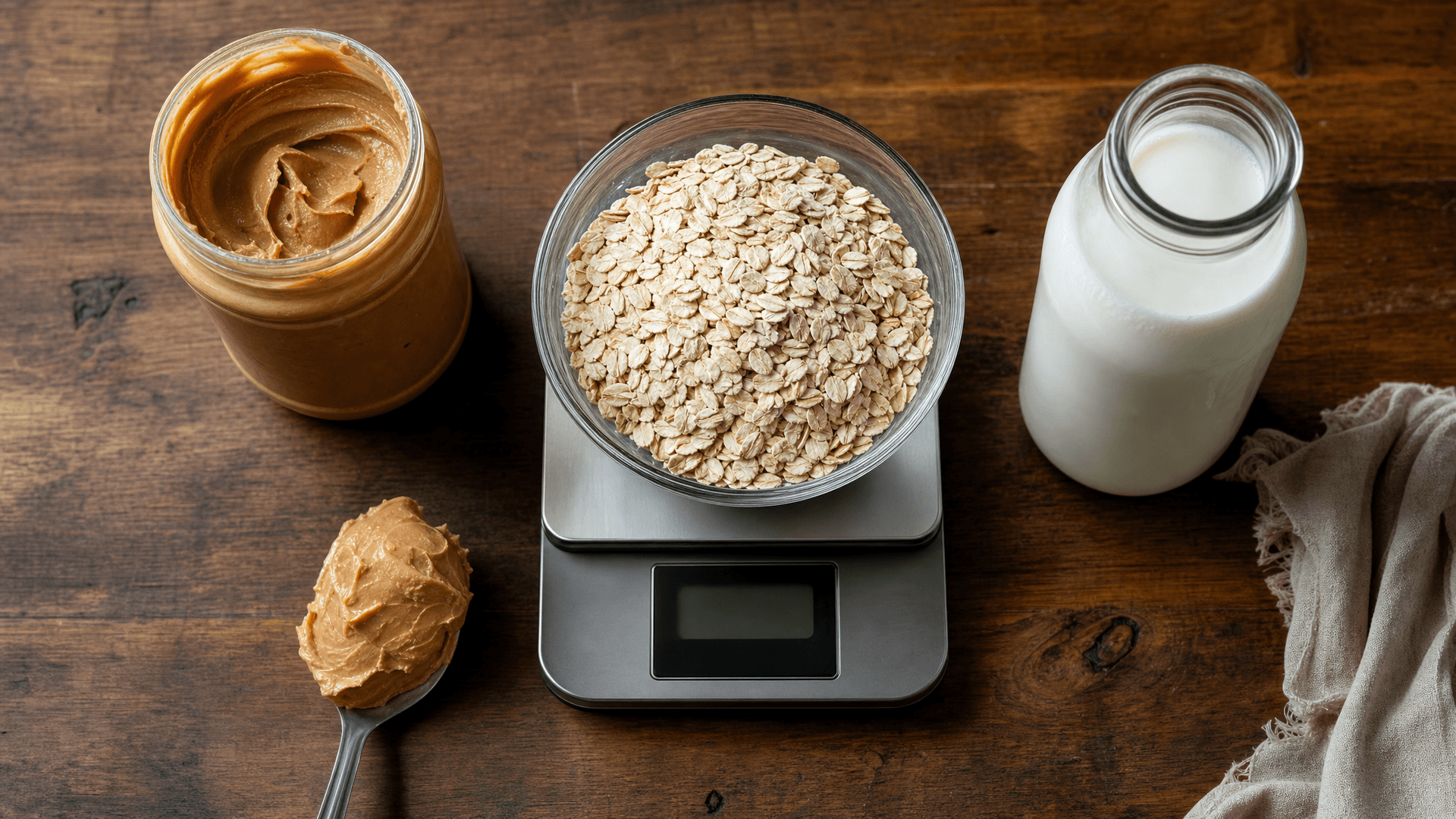
You've been bulking for four months. You log everything. Your app says 3,400 calories a day, every day, like clockwork. And the scale hasn't moved since April.
So you do what everyone does — you assume your metabolism is broken, or you're one of those "cursed hardgainers," or you need to add another shake. What you don't consider is that your log might be wrong. Not sloppy-wrong. Systematically wrong, in one direction, because you've been reading the front of the package instead of the back — and because the back of the package is legally allowed to be off by a fifth in the direction that hurts you.
This isn't a conspiracy. It's just regulation written for a country trying to lose weight, applied to a guy trying to gain it. Every tolerance, every rounding rule, every serving-size convention was designed to stop food companies from hiding calories from dieters. Not one of them was designed to stop a company from promising calories it doesn't deliver.
Here's how to decode any package in about 15 seconds, and where the 300+ daily calories are hiding.
- Nutrition labels have a legal tolerance of roughly 20 percent, and the rules protect dieters, not bulkers
- The serving size on the panel is a reference amount, not a portion — always check grams per serving
- Rice, pasta and oats are labeled by dry weight but eaten cooked, which is the single biggest logging error in bulking
- European labels show per 100g and per serving side by side, and apps frequently grab the wrong column
- Cheap protein powders can inflate their protein number with free amino acids that do nothing for muscle
- Weigh the package, not the serving — the total on the container is the only number nobody can round
The label is legally allowed to be wrong
Start here, because it reframes everything else.
In the US, nutrition labels aren't required to be exact. They're required to be within a compliance tolerance, and that tolerance is asymmetric on purpose. For nutrients regulators want you to get enough of — protein, fiber, vitamins — the product must contain at least 80 percent of what the label declares. For nutrients they want you to avoid — calories, fat, sugar, sodium — the product must contain no more than 120 percent of the declared amount.
Read those two sentences again from a bulker's chair.
A bar labeled 250 calories that actually contains 195 calories violates nothing. Nobody gets fined for that. The rule exists to stop a 250-calorie label on a 320-calorie bar, because that's the direction that hurts a dieter. The direction that hurts you — a generous calorie declaration on a stingy product — is regulatory open season.
Same for protein. A powder declaring 25g per scoop is compliant at 20g. That's not fraud, that's the floor of the rule. And the EU is looser still: EU labeling guidance treats declared energy values as averages with tolerances that widen for lower-calorie products, and there's no requirement to test every batch.
Most brands land close to their numbers — testing costs money and lawsuits cost more. But across a day built on ten packaged items, small legal shortfalls stack in the same direction. A 3,400-calorie log made mostly of packaged food can easily be a 3,150-calorie day. That's the difference between gaining and stalling.
The fix isn't paranoia. It's building your bulk on foods where the label can't drift much — whole foods, single-ingredient staples, things you weigh raw — and treating packaged goods as the flexible top layer, not the base.
Trap 1: The serving size is not your portion
The number at the top of the panel is a reference amount, set by regulation to reflect what a typical person supposedly eats in one sitting. It is not a recommendation, not a portion, and very often not a realistic quantity of food.
Granola is the classic offender. The panel says a serving is 1.6 oz and that serving is 210 calories. Cool. Now go pour granola into a bowl the way you actually do it, and weigh it. It's 3.9 oz. You just ate two and a half servings — 525 calories — and if you logged "1 serving granola" you're down 315 calories before you've even had lunch.
It cuts both ways, and this is what makes it dangerous rather than merely annoying. Peanut butter's reference serving is 1.1 oz, roughly two level tablespoons. Most people's "two tablespoons" is a heaped, scraped, licked-off-the-knife 1.6 oz. There you're over-logging if you eyeball it low and under-logging if you eyeball it high, and you have no idea which.
The move is simple and it never fails: ignore the serving count entirely and log by grams. Find the "per serving" line, note the gram weight next to it, weigh what you actually took, and let the app do the math. If the panel says 1.6 oz is 210 calories and your bowl reads 3.9 oz, you ate 513 calories. Done.
Set your kitchen scale to grams and leave it there, even if you think in pounds and ounces. Grams are what labels are written in, they're whole numbers instead of decimals, and every logging app takes them natively. You're not converting anything — you're just reading.
This is also the fastest way to catch the "servings per container: about 2.5" games. That "about" is doing real work. A bottle holding 2.5 servings means anyone drinking the whole thing has to multiply — and nearly nobody does.
Trap 2: The rounding rules that make calories vanish
Labeling rules allow rounding, and rounding always simplifies toward zero.
Calories under 5 per serving can be declared as 0. Calories between 5 and 50 round to the nearest 5. Above 50, they round to the nearest 10. Fat under 0.5g per serving declares as 0g. Same for a bunch of other line items.
On its own that's trivial. Combined with a small reference serving, it becomes a magic trick.
Cooking spray is the purest example. It's oil. Oil is 9 calories per gram, and the can is nearly all fat. But the reference serving is a spray of roughly a third of a second, which is a fraction of a gram, which rounds to 0g fat and 0 calories. The panel says zero. The can contains several hundred calories. Nobody lied.
For a dieter that's a problem. For you, honestly, it's free calories you're getting and not counting — fine. The version that actually costs you is the same mechanic running on things you are counting: a "0g sugar" flavored syrup that's 0.4g per pump and you use six, an oat milk rounding down per 8.5 oz pour, a seasoning blend that's quietly maltodextrin.
The general principle: the smaller the declared serving, the less you can trust the small numbers on that panel. Rounding error scales with how many servings you eat.
Don't try to correct for rounding by inflating your log. You'll compound guesses. The correct response is structural — get most of your calories from foods with large, honest serving sizes where rounding is noise, and stop treating tiny-serving products as macro sources at all.
Trap 3: Per 100g versus per serving
If you buy any European or UK product — and most protein powders, oats, and imported snacks qualify — the panel shows two columns. One is per 100g, which is mandatory under EU rules. The other is per serving or per portion, which is optional and defined by the manufacturer.
Two columns, similar-looking numbers, and this is where logging apps go to die.
Scan a barcode and half the time the database entry was built from the per-100g column while the front of the pack advertises the per-serving figure, or vice versa. A muesli showing 380 calories per 100g and 190 per 1.8 oz serving can end up in your log as either — and if the app picked the serving column while you weighed 3.5 oz, you've logged half of what you ate.
For a bulk, the per-100g column is your friend. It's standardized, it's always there, it's directly comparable across brands, and it's the one number a manufacturer can't shrink to make their product look lighter. Weigh in grams, read per 100g, multiply.
Here's what that comparison looks like when you actually run it on three "healthy granolas" from the same shelf:
| Product | Per 100g | Declared serving | Per serving | Real bowl (110g) |
|---|---|---|---|---|
| Brand A | 465 cal | 40g | 186 cal | 512 cal |
| Brand B | 420 cal | 55g | 231 cal | 462 cal |
| Brand C | 490 cal | 30g | 147 cal | 539 cal |
Brand C looks like the lightest option on the front of the box. It's the most calorie-dense product on the shelf. It just picked the smallest serving.
For a deeper look at how these errors compound across a whole day of logging, we broke it down in 6 calorie tracking mistakes that stall your bulk — serving-size drift is only one of them, and it's not even the worst.
Trap 4: Cooked-weight confusion on rice, pasta and oats
This is the big one. If you only fix one thing from this article, fix this.
Dry goods are labeled by dry weight. The panel on your pasta box describing 2.8 oz at 280 calories means 80 grams of hard, uncooked pasta. That same pasta, boiled, weighs somewhere around 7 oz because it absorbed water. Water has no calories. The macros didn't change — the weight nearly tripled.
Now watch what happens when you cook first and weigh second.
You boil a batch, plate up a portion, put it on the scale, get 9 oz, and log "250g pasta." Your app, pulling from a dry-weight entry, returns roughly 875 calories. You actually ate about 3.5 oz dry — around 350 calories. You just over-logged by more than 500 calories in a single meal.
Do that once a day with rice or pasta and your carefully engineered 3,400-calorie bulk is a 2,900-calorie maintenance day. You'll swear you're eating a mountain of food. You are — of water.
The reverse error exists too, and it's rarer but sneakier: some prepared and frozen products are labeled cooked, and precooked rice pouches often declare per pouch as sold. Mixing those with dry-weight entries in the same log means half your carbs are counted one way and half the other.
Weigh grains, pasta and oats dry, before cooking, and log that number. Cook whatever quantity you want afterwards. If you're batch-cooking for the week, weigh the total dry amount, cook it, weigh the total cooked amount, and divide — a batch of 500 grams dry rice that comes out at 1,400 grams cooked means every 100 grams on your plate is 36 grams dry. Write the ratio on a sticky note on the container.
Meat runs the same problem in the opposite direction — it loses water and gets more calorie-dense per gram as it cooks, so 7 oz of raw chicken becomes roughly 5.3 oz on the plate at the same calories. We covered the full raw-versus-cooked conversion, including the yield factors for the common meats, in how to weigh food for macros: cooked vs raw.
Trap 5: Protein spiking in cheap powders
Protein content on a label isn't measured by counting protein. It's usually derived from nitrogen content, because protein contains nitrogen and nitrogen is cheap to test for.
Which creates an obvious exploit: add cheap nitrogen-containing compounds that aren't complete protein, and the test reads higher. Free amino acids like glycine and taurine, plus creatine, all contain nitrogen. They cost a fraction of whey. Dumping a few grams into each scoop can inflate the declared protein number without adding meaningful muscle-building protein — this is what people mean by "protein spiking" or "nitrogen spiking."
You don't need a lab to spot it. You need the ingredients list, which is ordered by weight.
Red flags on a protein powder:
- Free-form amino acids listed individually — glycine, taurine, alanine, glutamine — high up in the ingredients rather than as a token flourish at the end
- An "amino acid blend" or "amino spike matrix" as a named ingredient
- A declared 25g protein per 1.2 oz scoop where the ingredients list runs six items deep before you reach whey
- Suspiciously cheap per kilo compared to everything else on the shelf, with no explanation
The clean version is boring: whey protein concentrate or isolate, a flavoring, a sweetener, maybe lecithin and a thickener. Four or five ingredients. A quality powder hits roughly 24g of protein in a 1 oz scoop, which tells you the scoop is about 80 percent protein by weight. If a scoop weighs 1.4 oz and claims 24g protein, the other 16 grams are doing something, and it's probably filler.
Weigh a scoop once when you open a new 4.4 lb tub. Scoops are notoriously inconsistent, they get packed down in shipping, and "one scoop" is a suggestion — the gram weight in the panel is the fact.
Protein spiking matters more than it sounds like it should. If you're targeting 0.8 g per lb of bodyweight and two of your daily shakes are quietly delivering 18g instead of 25g, you're 14g short every day without a single logging error. That's a real gap in a bulk, and it shows up as slower recovery long before it shows up on the scale.
The 15-second decode
Here's the routine. Do it once per new product, never again.
One — flip the package over. Everything on the front is marketing. "High protein," "natural," "fuels performance," and every gram number printed in a starburst are chosen by the same people who chose the color of the box.
Two — find grams per serving, not servings per container. You want the weight, and you want to compare it to what you actually eat. If the declared serving is under 1.4 oz for something you eat by the bowl, assume you'll eat two to three servings and mentally price it accordingly.
Three — read per 100g if it's there. That's your comparison unit across every product in the category. Anything over 400 calories per 100g is dense enough to be a genuine bulking tool. Anything under 150 is volume, and volume is your enemy right now.
Four — check whether the weight is as-sold or as-eaten. Dry goods, frozen goods and anything you'll add water to need this check. Look for "dry," "uncooked," "as packaged," or "as prepared" in the small print above the panel.
Five — scan the first three ingredients. Ingredients are listed by weight. The first three are most of the product. If you bought a protein product and none of the first three are a protein source, you bought a candy bar with a claim on it.
That's it. Fifteen seconds, once, and that product is decoded forever. Save the entry in your app under the gram weight you actually eat and you never think about it again.
Where the missing 300 calories actually live
Let's make this concrete for a 155 lb guy at 5'10" eating a normal bulking day and trying to gain 0.9 lb a week.
| Item | What he logs | What's really happening | Gap |
|---|---|---|---|
| Cooked rice logged as dry | 780 cal | 260 cal eaten | −520 |
| Bagged salad-style "healthy" lunch | 620 cal | Label tolerance, low end | −70 |
| Cheap protein shake ×2 | 50g protein | ~38g real protein | −12g protein |
| Granola bowl by "1 serving" | 210 cal | 110g eaten | +300 |
| Oil in the pan, not logged | 0 cal | 1 tbsp | +120 |
The rice line alone swamps everything else. Note that two of these errors run toward him — the un-logged oil and the heaped granola — which is exactly why this stuff is so hard to notice. The errors don't all point the same way, so the day feels roughly right. It's just off by enough to erase the surplus.
The fix isn't logging harder. It's logging the two or three items that carry most of your calories with real precision — the grains, the oils, the protein — and being relaxed about the rest. If you want the full framework for deciding which foods deserve the scale and which don't, our complete guide to tracking macros for bulking lays out the whole system.
When you're done fighting labels
Here's the thing nobody says out loud: this is a lot of work for someone whose actual goal is to get bigger.
You didn't start lifting because you wanted to become an amateur regulatory analyst. You wanted to fill out a t-shirt. And every hour spent auditing granola panels is an hour not spent training, sleeping, or eating.
That's the problem FuelTheGains was built around. Instead of handing you a target and wishing you luck against a supermarket full of misleading packaging, it builds your surplus out of specific foods in specific gram amounts — with the raw-versus-cooked question already resolved, and the calorie-dense staples doing the heavy lifting so a few percent of label drift can't derail the week. You get a plan you can weigh and cook, not a number you have to defend.
If you're tired of doing forensic accounting on your own groceries, . It takes about two minutes and it's built specifically for guys who struggle to eat enough.
The bottom line
The label isn't your enemy, but it isn't your friend either. It's a legal document written to a standard that assumes you're trying to eat less, and you're trying to eat more.
Weigh in grams. Read per 100g. Weigh dry goods dry. Check the ingredients on anything that claims protein. That's the whole discipline, and it takes fifteen seconds per new product.
Do that for two weeks and one of two things happens. Either your log gets honest and you find the 300 calories you'd been losing — or it confirms you really are eating what you thought, and you can raise your target with confidence instead of guessing. Both are wins. Both beat blaming your metabolism for a rice conversion error.