
Working the night shift doesn't just mess with your sleep. It wrecks your eating schedule, kills your appetite at weird hours, and makes "eating enough" feel like a second job.
If you're a skinny guy trying to bulk while working nights, you already know the struggle. You wake up at 4 PM with zero hunger. You eat a sad meal in a break room at 2 AM. And by the time you get home at 7 AM, you're too exhausted to do anything but crash.
Here's the thing — your body doesn't care what the clock says. It cares about total calories, total protein, and consistency. Night shift bulking isn't harder because of biology. It's harder because of logistics. And logistics can be solved.
This guide breaks down exactly how to structure your meals, time your nutrition around training, and hit your calorie targets — no matter when your "day" starts.
- Your body builds muscle based on total daily intake, not clock time
- Structure 4-5 meals around your shift, not around traditional breakfast/lunch/dinner
- Eat your biggest meal 2-3 hours before your shift starts
- Train either before your shift or on your days off — not after a full night of work
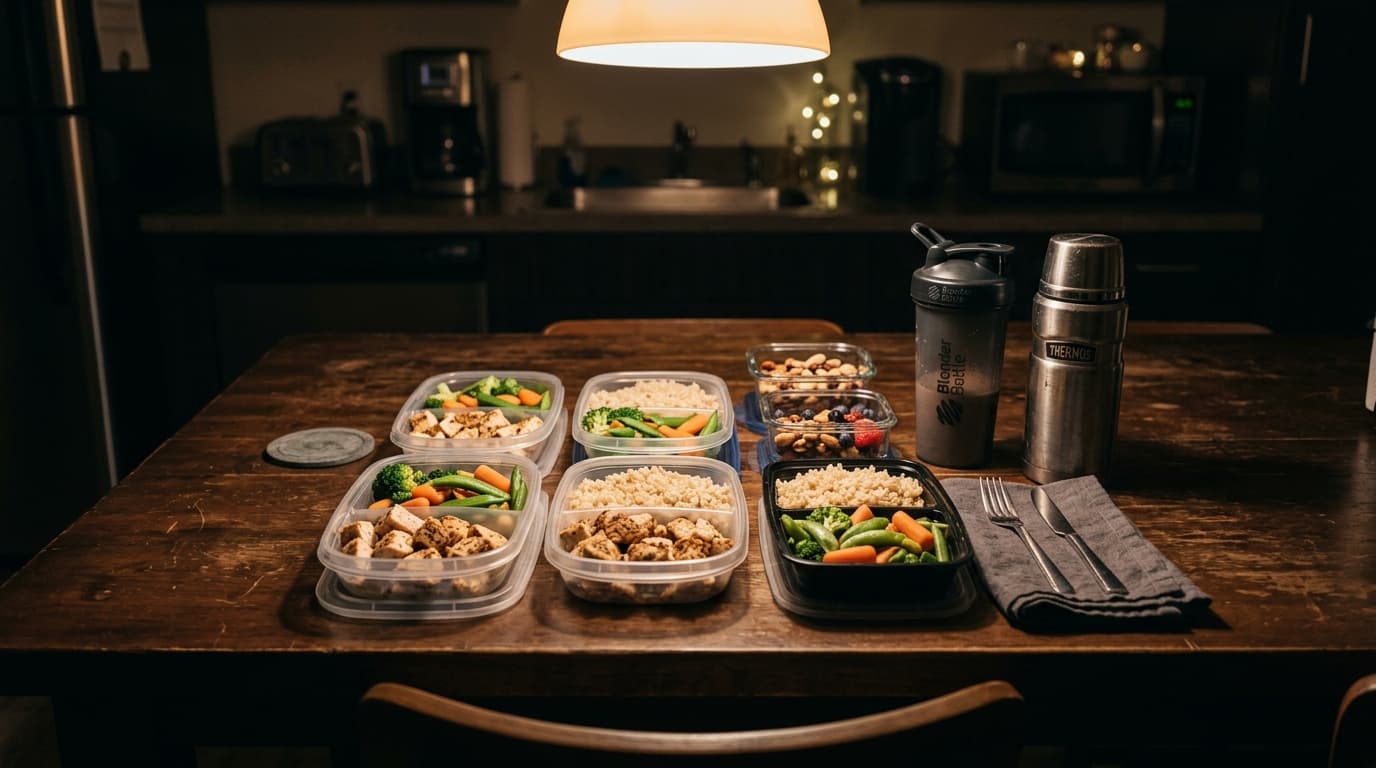
- Prep everything in advance — night shift leaves zero room for improvisation
- Liquid calories are your secret weapon for the 2-4 AM appetite dead zone
Why Night Shift Makes Bulking Hard
Let's be honest about what you're up against. It's not just "eat more" — there are real physiological challenges.
Your Appetite Disappears at Night
Your body runs on a circadian rhythm. Hunger hormones like ghrelin peak during the day and drop at night. Even if you're awake at 3 AM, your body isn't screaming for food the way it would at noon. This means you'll naturally under-eat during your shift if you rely on hunger cues.
Digestion Slows Down
Your digestive system is less efficient at night. Food sits heavier, you feel bloated faster, and large meals can cause discomfort. This is why many night shift workers eat tiny meals and end up in a calorie deficit without realizing it.
Sleep Quality Suffers
Daytime sleep is lighter and shorter than nighttime sleep. Poor sleep reduces testosterone, increases cortisol, and impairs muscle protein synthesis. You're already fighting with one hand tied behind your back — which makes nailing your nutrition even more important.
Decision Fatigue Is Real
After a 10-12 hour shift, your willpower is toast. If you don't have meals prepped and ready, you'll grab whatever's easiest — which is usually vending machine garbage or nothing at all.
Studies show that shift workers can build muscle just as effectively as day workers when total calorie intake, protein, and training volume are matched. The obstacle isn't your biology — it's your system.
Step 1: Calculate Your Bulking Calories
Before worrying about meal timing, you need to know your numbers. This doesn't change just because you work nights.
Here's the quick formula:
- Find your maintenance calories: Bodyweight in lbs × 15 = approximate TDEE
- Add your surplus: +300 to +500 calories for a lean bulk
- Set your protein: 0.8-1.0g per lb of bodyweight
Example: A 154 lb guy working nights with moderate activity:
| Macro | Target |
|---|---|
| Calories | 2,800-3,000 |
| Protein | 123-154g |
| Carbs | 350-400g |
| Fat | 80-100g |
If you've never calculated your bulking calories before, check out our full guide on how to calculate your bulking calories — it walks through everything step by step.
Night shift workers often overestimate their activity level. Unless your job is physically demanding (warehouse, construction), you're probably "lightly active" despite being awake for 12+ hours.
Step 2: Build Your Night Shift Meal Schedule
Forget breakfast, lunch, and dinner. Those labels mean nothing when you wake up at 3 PM and go to bed at 8 AM. Instead, think in terms of meal slots relative to your schedule.
Here's a framework for a typical night shift (10 PM - 6 AM):
The 5-Meal Framework
| Meal | Time | What | Calories |
|---|---|---|---|
| Meal 1 (Wake-up) | 3:00 PM | Biggest meal — protein + complex carbs + fats | 700-800 |
| Meal 2 (Pre-shift) | 7:00 PM | Moderate meal — protein + carbs | 550-650 |
| Meal 3 (Mid-shift) | 12:00 AM | Easy meal — prepped food or shake | 500-600 |
| Meal 4 (Late shift) | 3:00 AM | Liquid calories — shake or smoothie | 400-500 |
| Meal 5 (Post-shift) | 6:30 AM | Light meal — easy to digest before sleep | 400-500 |
Total: ~2,550-3,050 calories
Why This Works
- Meal 1 is your anchor. You've just woken up, appetite is highest, and you have time to cook. Load up here.
- Meal 2 fuels your shift. Eat this 2-3 hours before clocking in so you're not sluggish.
- Meals 3-4 are survival mode. Your appetite is lowest here. Keep it simple — prepped containers or shakes.
- Meal 5 is strategic. You need fuel for recovery and sleep, but nothing so heavy it keeps you up.
Don't skip Meal 5. Going to bed on an empty stomach after a 10-hour shift means 8+ hours with no fuel for recovery. Even a small meal makes a big difference.
Step 3: What to Eat at Each Meal
Here's a practical breakdown with real food options. No fancy recipes — just stuff you can actually prep and bring to work.
Meal 1: The Big One (Wake-Up — ~3 PM)
This is where you front-load your calories. You've got a kitchen, an appetite, and time. Use all three.
Option A:
- 7 oz chicken thighs (pan-fried or air-fried)
- 1.5 cups cooked rice
- 5 oz roasted sweet potato
- 1 tbsp olive oil
- Side salad
~750 cal, 52g protein
Option B:
- 4-egg omelette with cheese and veggies
- 2 slices whole-grain toast with butter
- 1 cup oatmeal with banana and honey
~800 cal, 45g protein
Option C:
- 7 oz ground beef (90/10) with taco seasoning
- 2 flour tortillas
- Rice, salsa, cheese, sour cream
~780 cal, 50g protein
Meal 2: Pre-Shift Fuel (~7 PM)
Moderate meal. Enough to sustain you but not so heavy you feel sluggish clocking in.
- 6 oz grilled chicken breast
- 1 cup cooked pasta
- 3.5 oz broccoli
- 1 tbsp butter on the pasta
~600 cal, 48g protein
Meal 3: Mid-Shift Container (~12 AM)
This is your prepped meal. It sat in a cooler bag or work fridge for hours. It needs to taste good cold or microwaved.
Best options for packed meals:
- Rice bowls with chicken or beef
- Wraps with turkey, cheese, and avocado
- Pasta with meat sauce (reheats well)
- Grain bowls with chickpeas and feta
Check out our meal prep guide for muscle gain for more container-friendly meal ideas.
Target: ~550 cal, 35-40g protein
Meal 4: The 3 AM Shake
This is the meal most night shift workers skip — and it's the reason they can't bulk. At 3 AM, you don't want to chew. You don't want to think. You want to drink something and move on.
The Night Shift Bulk Shake:
- 2 cups whole milk
- 1 scoop whey protein
- 2 tbsp peanut butter
- 1 banana
- ¼ cup oats
~700 cal, 48g protein
Blend this before your shift and keep it in a shaker or thermos. It's your lifeline.
For more shake ideas, check out our homemade mass gainer shake recipes.
If you can't stomach a thick shake at 3 AM, dilute it with more milk and sip it over an hour. Getting 70% of a shake down is better than skipping it entirely.
Meal 5: Pre-Sleep (~6:30 AM)
You need calories for overnight recovery, but nothing that'll cause acid reflux while you're trying to sleep.
Good options:
- Greek yogurt with granola and berries (~400 cal, 30g protein)
- 2 slices toast with peanut butter and a glass of milk (~450 cal, 20g protein)
- Cottage cheese with fruit and honey (~350 cal, 28g protein)
Avoid: spicy food, large portions of red meat, anything deep-fried. Your digestion is already compromised — don't make it worse.
Step 4: When to Train
This is the million-dollar question for night shift workers. There's no perfect answer, but there are clear winners and losers.
Option A: Train Before Your Shift (Best for Most People)
Schedule: Gym at 5-6 PM, shower, Meal 2, head to work.
Pros:
- You're fueled from Meal 1
- Energy levels are decent (you've been up for 2-3 hours)
- Post-workout nutrition is easy (Meal 2 + shift meals)
Cons:
- Tight window between waking up, eating, digesting, and training
- Can feel rushed on days with errands
Option B: Train on Days Off
Schedule: Gym whenever you want on your 2-3 off days.
Pros:
- No time pressure
- Better energy and focus
- Can follow a normal eating schedule
Cons:
- Only 2-3 sessions per week (unless you do both)
- Need to maintain consistency across shifting schedules
Option C: Train After Your Shift (Least Recommended)
Schedule: Gym at 7 AM after clocking out.
Pros:
- Gets it out of the way
Cons:
- You're exhausted after 8-10 hours of work
- Cortisol is high, testosterone is low
- Cuts into sleep time
- Higher injury risk from fatigue
Train 2x before your shift during work weeks, and 1-2x on off days. This gives you 3-4 sessions per week without destroying your recovery.
Step 5: Meal Prep Like Your Gains Depend on It
Because they do. Night shift + no prep = no gains. Period.
The Sunday System
Spend 2 hours on your day off prepping:
- Cook 2-3 lbs of protein (chicken thighs, ground beef, or turkey)
- Make a big pot of carbs (rice, pasta, or potatoes)
- Prep 4-5 containers with portioned meals for your mid-shift eating
- Pre-make 3-4 shakes (store dry ingredients in bags, just add liquid at work)
- Stock your break room stash — protein bars, nuts, dried fruit
Your Work Bag Essentials
Never show up to a shift without these:
- 2 prepped meal containers
- 1 shaker bottle with protein powder
- 1 pre-made shake (in thermos/insulated bottle)
- Snack bag: trail mix, protein bars, beef jerky
- 1 gallon water jug
If you're on a budget, our bulking grocery list will help you keep costs under control while buying in bulk.
Invest in a good insulated lunch bag with ice packs. Gas station food at 2 AM will never support a bulk — your prepped meals will.
Step 6: Manage Your Sleep for Recovery
You can eat perfectly and train hard, but if your sleep is garbage, you won't grow. Night shift sleep requires active management.
Non-Negotiable Sleep Rules
- Blackout your room completely. Blackout curtains + eye mask. Any light disrupts melatonin production.
- Keep it cold. 60-67°F is the sweet spot for deep sleep.
- Set a consistent schedule. Go to bed within the same 1-hour window every day, even on off days.
- Stop caffeine 6 hours before bed. If you sleep at 8 AM, your last coffee is 2 AM.
- Eat Meal 5 at least 30 minutes before lying down. Gives your stomach time to settle.
How Much Sleep Do You Need?
Minimum 7 hours. If you're consistently getting less than 6.5 hours, your muscle protein synthesis drops significantly. Aim for 7-8 hours of actual sleep (not just time in bed).
If you're struggling with sleep quality, our guide on sleep and recovery for muscle growth goes deeper into the science and practical fixes.
Melatonin (0.5-3mg) taken 30 minutes before your target sleep time can help shift workers fall asleep faster. It's not a sedative — it signals your brain that it's "night." Talk to your doctor before starting any supplement.
Step 7: Handle the Common Night Shift Problems
"I have zero appetite at 2-3 AM"
This is normal. Your ghrelin levels are naturally low at night. Solutions:
- Drink your calories. Shakes, smoothies, chocolate milk — anything liquid
- Eat smaller, more frequent bites. Instead of one 500-cal meal, graze on 5 small snacks
- Avoid heavy fiber and raw vegetables during your shift — they fill you up with minimal calories
- Use calorie-dense foods like nuts, peanut butter, cheese, and dried fruit
For more ideas on foods that pack calories without filling you up, check out high-calorie foods that don't fill you up.
"I'm too tired to cook when I wake up"
- Meal prep on your days off (see Step 5)
- Use slow cooker meals — set it before you sleep, eat when you wake up
- Keep "zero-effort" options ready: rotisserie chicken, pre-cooked rice, canned beans
- Batch cook and freeze individual portions
"My shift schedule rotates"
Rotating shifts (days one week, nights the next) are the hardest scenario. Your priority is keeping total daily intake consistent regardless of when you eat. Have a meal plan for each shift pattern and switch between them.
"I can't track macros at work"
You don't need to track in real-time. Prep your meals with known macros, eat what you prepped, and log it all at once before bed. If you prepped it, you already know what's in it.
"My coworkers eat junk and I get peer pressured"
Bring your own food. Every time. If someone offers you gas station pizza at 1 AM, you already have a container of chicken and rice. It's not willpower — it's preparation eliminating the choice.
A Full Day Example: The Night Shift Bulk
Here's what a complete day looks like for a 154 lb guy working 10 PM - 6 AM and targeting 2,900 calories:
| Time | Meal | Food | Cal | Protein |
|---|---|---|---|---|
| 3:00 PM | Wake-up meal | 4-egg omelette, toast, oatmeal with banana | 800 | 45g |
| 5:30 PM | Pre-workout | Banana + handful of almonds | 250 | 7g |
| 6:00 PM | Training | 60-minute lifting session | — | — |
| 7:15 PM | Pre-shift meal | Chicken breast, pasta, broccoli, butter | 600 | 48g |
| 10:00 PM | Shift starts | — | — | — |
| 12:00 AM | Mid-shift meal | Prepped rice bowl with ground beef | 550 | 38g |
| 3:00 AM | Late-shift shake | Milk, whey, PB, banana, oats | 700 | 48g |
| 6:00 AM | Shift ends | — | — | — |
| 6:30 AM | Pre-sleep meal | Greek yogurt, granola, berries | 400 | 30g |
| 7:30 AM | Sleep | — | — | — |
| Total | 3,300 | 216g |
That's 3,300 calories and 216g protein — more than enough for a lean bulk. And notice: no single meal is overwhelming. The biggest is 800 calories. The hardest one (3 AM) is a shake.
Supplements That Actually Help Night Shift Workers
Most supplements are a waste of money. But a few genuinely help when your schedule is flipped.
| Supplement | Why It Helps | Dose |
|---|---|---|
| Creatine monohydrate | Supports muscle recovery even with suboptimal sleep | 5g daily |
| Vitamin D3 | You're missing sunlight — most night shift workers are deficient | 2,000-4,000 IU daily |
| Magnesium glycinate | Improves sleep quality, reduces muscle cramps | 200-400mg before bed |
| Melatonin | Helps reset your sleep cycle for daytime sleeping | 0.5-3mg before bed |
| Whey protein | Convenient way to hit protein targets during shifts | 1-2 scoops as needed |
For a deeper dive on supplements, read our complete bulking supplement guide.
Night Shift Bulking vs. Day Shift Bulking: What's Actually Different?
Let's cut through the noise. Here's what changes and what doesn't:
What stays the same:
- Total calorie needs
- Protein requirements
- Training principles (progressive overload, compound lifts)
- The need for consistency
What changes:
- Meal timing — shifted to match your awake hours
- Meal composition — lighter meals during the shift, heavier meals at home
- Prep importance — goes from "nice to have" to "absolutely essential"
- Sleep management — requires active effort instead of just "going to bed"
- Supplement needs — Vitamin D and melatonin become more relevant
The fundamentals don't change. The execution does. And now you have the execution plan.
How FuelTheGains Makes Night Shift Bulking Easier
Building a meal plan around a night shift schedule takes work. Calculating your calories, figuring out what to eat at 3 AM, prepping meals that travel well — it's a lot of moving parts.
That's exactly what was built for. You plug in your schedule, your shift times, and your goals, and it builds a personalized meal plan that actually fits your life. Not a generic "eat 6 meals a day" template — a real plan with meals sized for your appetite, timed for your shift, and prepped for your schedule.
If you've been trying to bulk on night shift by winging it, stop guessing and let the system do the math.
The Bottom Line
Night shift bulking is a logistics problem, not a biology problem. Your muscles don't know what time it is. They know whether you fed them enough protein, gave them enough calories, trained them hard enough, and let them recover.
Nail those four things — with the schedule adjusted to your reality — and you'll grow just as fast as the guy who trains at 6 PM and sleeps at 10 PM.
The shift doesn't define your results. Your system does. Build the system, prep the food, and show up every day. The gains will follow.