
Almost every bulking guide out there assumes two things: you do the grocery shopping, and you cook your own food.
If you're 19 and living at home, neither one is true. Dinner happens at 7pm because that's when it happens. The portion on your plate is the portion you were given. The pantry has whatever your parents like eating, and there's a decent chance that's a lot of vegetables and not much rice.
So you do the math on a calorie calculator, it tells you to eat 3,200 calories, and you look at your plate of chicken and salad and think: how the hell am I supposed to get there?
Here's the thing though — living at home is actually one of the best bulking situations you can be in. You have a real kitchen. You have someone cooking real food for you. Your rent is zero, which means your entire food budget can go toward food that isn't already covered. Most guys in a dorm would kill for that.
You just need a system that works inside someone else's kitchen instead of fighting it. That's what this is.
- Living at home is a calorie-density problem, not a food problem — the food is there, it's just too lean
- Upgrade the plate you're handed instead of cooking a separate meal, it's faster and causes zero friction
- Fats are your main lever: oil, nut butter, cheese and full-fat dairy add hundreds of calories in seconds
- Own a small "my shelf" of high-calorie staples you buy with your own money — it removes every excuse
- Ask for grocery items with specific brands, quantities and offers to pay, never with vague complaints
- The gaps between family meals are where you lose 700-900 calories a day — fill them on a schedule, not on hunger
- Twenty minutes of prep on Sunday keeps you out of the kitchen at dinner time
First, Understand What's Actually Missing
You're not short on food. You're short on calorie density.
A typical home-cooked family dinner is built for people who aren't trying to gain 0.5-1 lb a week. It's portion-controlled. It's lean protein. It's a lot of volume from vegetables. Your parents might be actively trying to lose weight, which means the food in that house is optimized for the exact opposite of your goal.
Run the numbers on a normal plate:
| Item | Amount | Calories |
|---|---|---|
| Grilled chicken breast | one piece | 220 |
| White rice | one scoop | 200 |
| Steamed vegetables | a big pile | 60 |
| Plate total | — | 480 |
That's a genuinely good meal. It's also 480 calories in a day where you need something like 3,200. Three of those plates gets you to 1,440. You are not going to grow on 1,440 calories, no matter how hard you train.
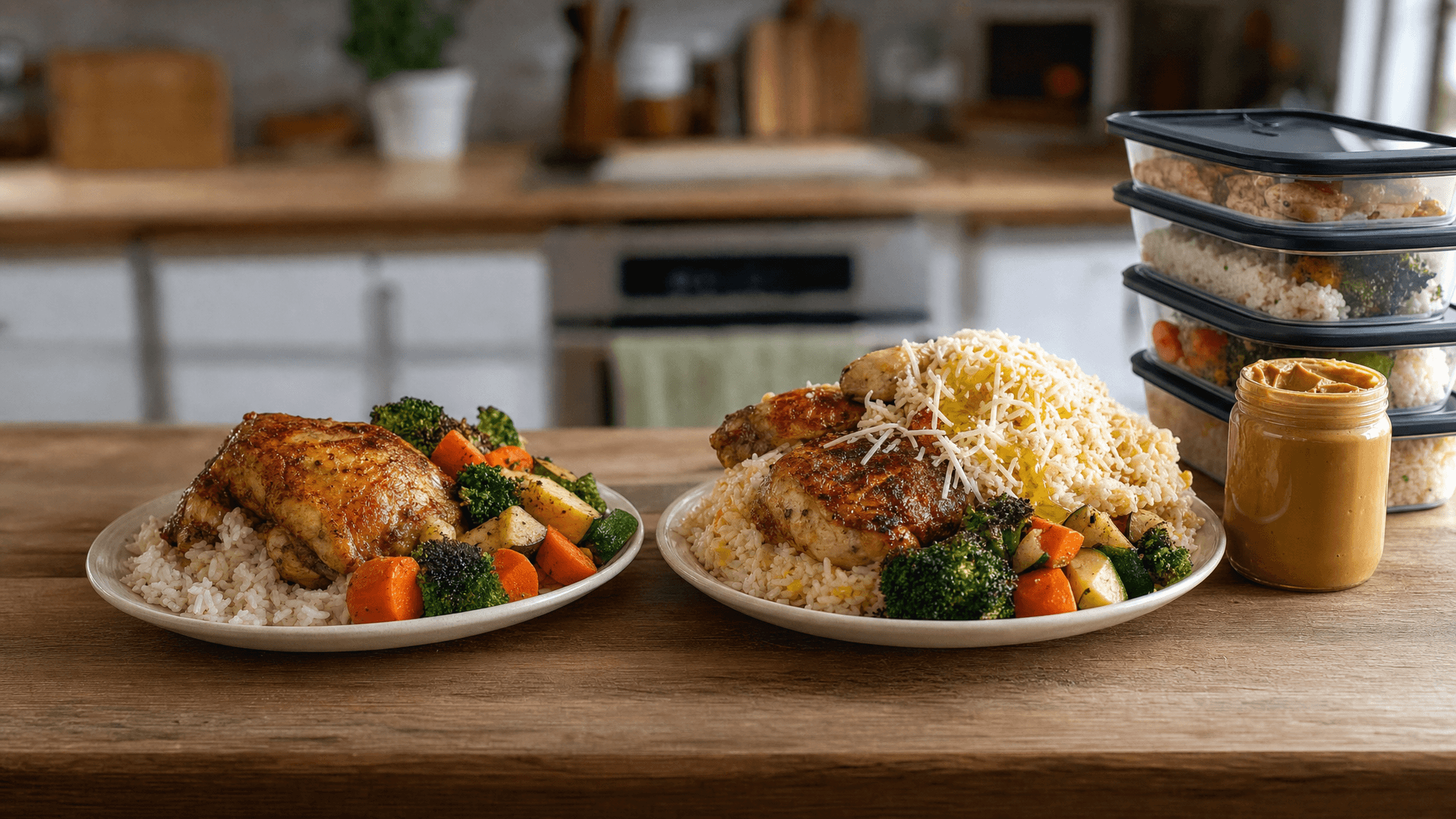
Now here's the same plate after ninety seconds of work at the counter:
| Item | Amount | Calories |
|---|---|---|
| Grilled chicken breast | one piece | 220 |
| White rice | two scoops | 400 |
| Steamed vegetables | smaller pile | 40 |
| Olive oil over the rice | 2 tbsp | 240 |
| Shredded cheese on top | a handful | 110 |
| Glass of whole milk | 1 cup | 150 |
| Plate total | — | 1,160 |
Same meal. Same kitchen. Same cook. 680 extra calories and you didn't ask anyone for anything.
That's the whole strategy in one table. You're not replacing family meals — you're upgrading them at the counter, in the ten seconds between the pan and the table.
Cooking a separate meal takes 30 minutes, occupies a stove someone else is using, creates dishes, and reads as a rejection of the food your parents made. Upgrading the plate takes 90 seconds and nobody even notices. Pick the one you'll actually do 21 times a week.
Step 1: Get an Honest Baseline for One Week
Before you change anything, find out what you're actually eating. Not what you think you're eating — what's on the plate.
For seven days, log everything without trying to fix it. Use a food scale if you have one, eyeball it if you don't. You're looking for two numbers:
- Your current daily average. Most guys living at home land somewhere between 1,800 and 2,300 calories. If you're a 150 lb lifter who needs 3,200, that's a gap of roughly 1,000 calories a day.
- Where the calories aren't. Almost always it's the same three places: breakfast is coffee and nothing, lunch is small, and there's a five-hour hole between school or work and dinner.
You need to know the size of the gap before you can close it. Guessing leads to one of two failures — you undereat and stay the same weight for four months, or you assume you're eating way less than you are and start force-feeding yourself into feeling like garbage.
Also weigh yourself. Same time every morning, right after you wake up, before you eat. Write it down daily and only look at the weekly average — day-to-day swings of 2-4 lbs are water and food volume, not muscle or fat.
Step 2: The Plate Upgrade
This is the single highest-leverage habit in this entire article. Learn it once, do it every day, and you've solved most of the problem.
The rule: whatever gets served, you add fat, starch and dairy to it before you sit down.
The fat lever
Fat is 9 calories per gram versus 4 for protein and carbs. It's the fastest way to move a plate's number and it barely changes how full you feel.
- Olive oil — 2 tbsp is 240 calories. Goes over rice, pasta, roasted potatoes, vegetables, anything. Nobody questions olive oil.
- Butter — 1 tbsp is 100 calories. Stir it into rice or mashed potatoes while they're hot.
- Peanut butter — 2 tbsp is 190 calories. Not for dinner, but it turns any bread, fruit or oatmeal into a real meal.
- Cheese — 1 oz of shredded cheese is about 110 calories. Melts into pasta, chili, eggs, potatoes.
- Full-fat mayo or aioli — 1 tbsp is 90 calories on a sandwich that had none.
The starch lever
Take the second scoop. That's it. An extra 5 oz of cooked rice or pasta is another 200 calories, and if there's leftover starch in the pot it costs your family nothing.
If there's no rice or pasta on the table, that's what bread is for. Two slices with butter is 250 calories and takes zero cooking.
The dairy lever
A glass of whole milk with dinner is 150 calories for something you drink in twenty seconds. Two glasses a day across a week is 2,100 calories — that alone is a meaningful chunk of a bulk.
Put the olive oil bottle, a jar of peanut butter and a bag of shredded cheese where you can reach them without opening three cupboards. Friction is the reason people stop doing this in week two, and reaching is friction.
If you want the full breakdown of this approach with more combinations, we went deep on it in how to add 500 calories to any meal without feeling stuffed.
Do not dump oil on food in front of the person who cooked it and say "this needs more calories." That reads as a critique of their cooking, and it's how you end up in an argument about your "diet phase." Plate up at the counter, add what you need, sit down.
Step 3: Build Your Own Shelf
Here's where you stop being dependent on what's in the house.
Claim one shelf in the pantry and one shelf or drawer in the fridge. Buy the stuff on it with your own money. This does two things: it guarantees your staples are always there, and it completely defuses the "you're eating everything in this house" conversation before it starts.
You don't need much. Here's a starter shelf that runs roughly $25-35 and lasts two weeks:
| Item | Rough cost | Why it's on the list |
|---|---|---|
| Peanut butter (large jar) | $6 | ~190 cal per 2 tbsp, no prep |
| Oats (big bag) | $4 | Cheapest calorie base that exists |
| Whole milk | $4 | 150 cal a glass, drinkable calories |
| Eggs (18) | $5 | 70 cal each, cook in 3 minutes |
| Bananas | $3 | Pocket calories, blends into anything |
| Trail mix or raw nuts | $7 | ~180 cal per small handful |
| Tortillas or bagels | $4 | Turns anything into a portable meal |
| Olive oil (if there's none) | $8 | 120 cal per tbsp |
Everything on that list is shelf-stable or lasts a week, and none of it requires the stove. If you want the full version of this with a proper weekly budget, we broke it down in the ultimate bulking grocery list on a budget.
One more thing worth buying: a blender bottle and a bag of whey. A shake made with whole milk, a scoop of protein, a banana and 2 tbsp of peanut butter is 700 calories in 60 seconds, and you can make it in a kitchen that's occupied without getting in anyone's way. For a guy who needs 3,200 calories, one shake a day is over 20% of the target handled before you've cooked anything.
Buy a cheap food scale, around $12. Not to obsess — to calibrate. Weigh your oats and your peanut butter once, learn what 3 oz of oats and 2 tbsp of PB actually look like, then eyeball it forever after. Most people underestimate peanut butter by half and overestimate their rice portion.
Step 4: How to Ask for Groceries Without It Becoming a Thing
Most guys handle this badly. They say something like "there's never any food in this house" and are genuinely confused when it goes poorly.
The reason it goes poorly is that a vague complaint sounds like criticism of how the household is run. A specific request sounds like a favor. Same information, completely different reception.
What works
Be specific about the item. Not "can we get more protein." Instead: "Can you grab a rotisserie chicken and a big bag of rice when you go Saturday?" A concrete item goes on a list. A concept doesn't.
Give a number. "Two gallons of whole milk instead of one" is actionable. "More milk" is noise.
Offer to pay. Say it once, clearly: "I'll cover the extra, just tell me what it comes to." Nine times out of ten they'll wave you off, but offering completely changes how the request lands. It's now you contributing, not you demanding.
Explain the goal in one sentence, once. "I'm trying to gain 10 lbs before winter and I need to eat a lot more than I have been." Say it once, calmly, then never bring it up again. Parents respond well to a goal with a number and a deadline. They respond badly to ongoing commentary about their cooking.
Go with them. This is the cheat code. If you're in the store, you put things in the cart. No negotiation required, and you can pay for your own shelf items in the same trip.
Cook once a week. Make a big batch of something the whole family eats — chili, pasta bake, a tray of chicken thighs and potatoes. You get a hugely calorie-dense meal designed to your specs, and you've contributed labor to the kitchen. That single act buys you an enormous amount of goodwill for everything else on this list.
What doesn't work
Complaining about the cooking. Asking for a separate meal to be made for you. Announcing your macros at the table. Leaving passive-aggressive notes on the fridge. Eating a family-size bag of something at 11pm and leaving the empty bag out.
The easiest ask in the world: "Is there any more of that?" Leftover food that's already cooked is free calories with zero friction attached. Ask for seconds every single night. Most of the time the answer is yes, and nobody has ever been annoyed by someone enjoying their cooking.
Step 5: Fill the Gaps Between Family Meals
You get maybe two family meals a day. At an upgraded 1,000-1,100 calories each, that's around 2,100. You still need another 1,000, and it has to come from food you control completely.
The gaps are predictable. Here's what they look like and what goes in them.
Gap one: mornings
Nobody's cooking you breakfast at 7am, and you're not going to cook either. So don't cook.
Overnight oats, made the night before. 3 oz oats, a cup of whole milk, a scoop of whey, 2 tbsp of peanut butter, a banana. Stir it in a jar, put it in the fridge, grab it on the way out. Around 750 calories for two minutes of work at a time when the kitchen is empty.
Make three at once on a Sunday and your entire week of breakfasts is handled.
Gap two: the afternoon hole
Between getting home and dinner is usually four or five hours, and it's the biggest single loss in the day. This is where a shake goes.
Milk, whey, banana, peanut butter, a handful of oats if you want it bigger. 700-900 calories, made in one minute, doesn't touch the stove, doesn't spoil your dinner nearly as much as you'd expect because liquid calories empty out of your stomach fast.
If you'd rather chew: two tortillas with peanut butter and banana is 600 calories and travels in a backpack.
Gap three: before bed
The most underrated meal of the day when you live at home, because the kitchen is finally free and nobody's watching.
Options, all around 500-700 calories:
- 9 oz Greek yogurt, honey, granola, a handful of nuts
- Three scrambled eggs with cheese on two slices of buttered toast
- A bowl of cereal made with whole milk, plus a spoon of peanut butter stirred in
- Leftovers from dinner, reheated, with cheese added
The daily shape
| Slot | What | Calories |
|---|---|---|
| Breakfast | Overnight oats, made last night | 750 |
| Afternoon | Shake | 800 |
| Family dinner | Upgraded plate | 1,100 |
| Before bed | Yogurt bowl or eggs on toast | 600 |
| Total | — | 3,250 |
Two of those four are meals someone else's schedule dictates. The other two are entirely yours, cost you about three minutes of work combined, and they're where the bulk actually happens.
Notice what's not on that list: cooking a single separate meal. If your situation is more dorm-shaped than home-shaped, the same gap-filling logic applies with even fewer tools — we covered that version in the dorm room guide to bulking in college.
Step 6: The Twenty-Minute Sunday
You don't need a full meal-prep operation. You need twenty minutes on a Sunday when the kitchen is quiet, and you need it to leave the kitchen cleaner than you found it.
- Three jars of overnight oats. Five minutes. Breakfast solved through Wednesday.
- Boil a dozen eggs. Ten minutes of mostly waiting. 2 eggs is 140 calories of grab-and-go protein.
- Portion your nuts. Split a bag into small bags or containers of 1.5 oz each. Around 240 calories per bag, and having them pre-portioned is the difference between eating them and forgetting they exist.
- Cook a big pot of rice if the household is fine with it. Cold rice from the fridge reheats in 90 seconds and turns any leftover protein into a real meal.
Twenty minutes. Then wipe the counter down, because the single best investment you can make in this whole plan is being the person who doesn't leave a mess.
The Mistakes That Kill This
Eating on hunger instead of on schedule. If you're naturally skinny, your hunger signal is broken for this purpose — it tells you to eat maintenance calories, not surplus calories. Eat at set times whether you feel like it or not. This is the number one reason bulks fail and it has nothing to do with living at home.
Waiting for permission. Nobody is going to hand you a bulk. Your parents aren't going to start cooking for a 175 lb target weight because you mentioned the gym once. The shelf, the shakes and the gap meals are yours to run.
Only eating on training days. Muscle gets built on rest days. Rest day calories are the same as training day calories, full stop.
Cutting protein to make room for calories. You still need 0.7-1.0g per lb of bodyweight in protein. For a 155 lb guy that's around 120-155g a day. Family dinners usually cover a decent chunk of it — the shake and the eggs cover the rest.
Junk-food bulking because it's easy. Yes, a bag of chips is 900 calories. It's also 900 calories that leave you bloated, sluggish and puffy with nothing to show for it. Use the fat lever on real food instead — olive oil on rice does the same job without wrecking how you feel.
Being an annoying housemate. Finishing food someone was saving, leaving pans in the sink, being loud in the kitchen at midnight. Every one of those makes the next grocery request harder. Protect the relationship and the food gets easier.
Where FuelTheGains Fits
The reason most guys quit a bulk isn't willpower. It's that hitting 3,200 calories a day requires constant decisions — what to eat, how much, what's already in the house, what to buy this week, how to hit protein when dinner was a salad.
That's the exact problem we built to solve. You put in your numbers and your situation, and it gives you a plan that fits the food you actually have access to — including the reality that someone else is cooking dinner. It tells you what to add to a plate you didn't choose, what to buy for your own shelf, and what to eat in the gaps so you land on your target without doing the math three times a day.
It's not going to lift for you. It just removes the part where you stare into a fridge that isn't yours and give up.
The Bottom Line
Living at home isn't the obstacle you think it is. Free rent plus a working kitchen plus someone cooking dinner is a better setup than 90% of people trying to gain weight will ever have.
The gap is calorie density, and you close it with olive oil, whole milk, a second scoop of rice, a shake in the afternoon and something before bed. None of that requires anyone's permission, a separate meal, or a conversation about your diet.
Run it for eight weeks. Weigh yourself every morning, look at the weekly average, and if you haven't gained 0.5 lb in a week, add another 200 calories somewhere.
You've got a kitchen and someone who cooks. Use it.