
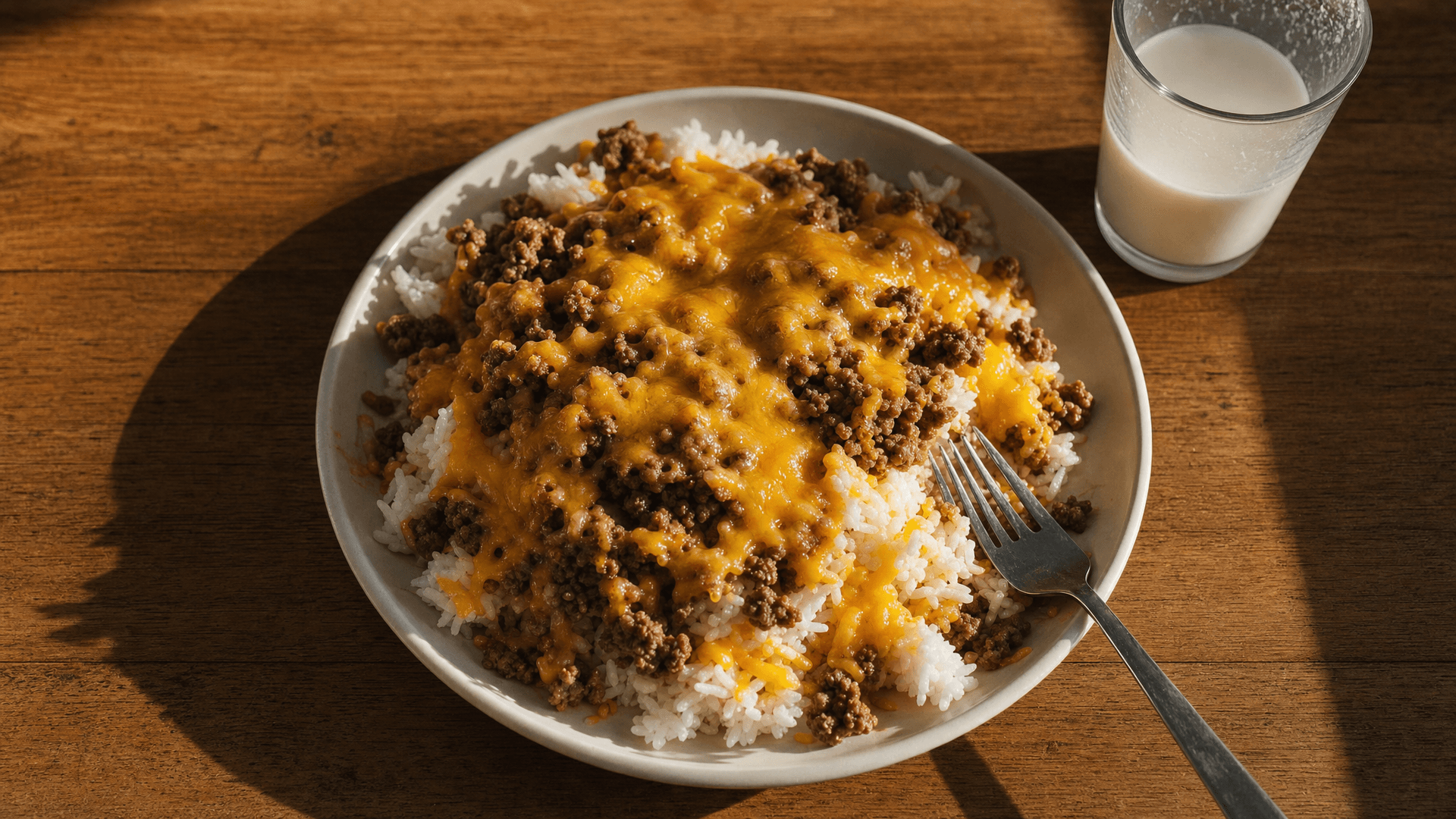
You finally did it. You stopped picking at your food, you cooked a real meal, and you put away something like 900 calories in one sitting.
Twenty minutes later you're horizontal. Eyes heavy, brain offline, absolutely useless for the next two hours. The lecture you were supposed to attend, the work block you'd planned, the training session — all of it just got downgraded to "maybe tomorrow."
Here's the frustrating part: you did the right thing. Eating more is the whole point of bulking. But nobody warned you that going from picking-at-food mode to serious-eating mode would cost you half your waking hours.
The good news is that the food coma isn't the price of admission. It's a structuring problem, not a calorie problem. You can eat the same total number of calories per day and feel completely different depending on how you split them, what you combine, and when you time them around training.
Let's break down exactly why the crash happens and how to eat big without wrecking your day.
- The crash comes from gastric load, blood sugar swings, and meal composition working together — not from calories alone
- A single meal over roughly 1,000 calories is where most guys start feeling wrecked
- Big carb-and-fat combos with low protein and low fiber cause the hardest crashes
- Splitting your surplus across 5-6 feedings beats hero meals for both energy and appetite
- Eat your pre-gym meal 90-120 minutes out, not 20 minutes out
- Liquid calories digest faster and hit your total without the sedation
- Protein and fiber flatten the blood sugar curve — never eat naked carbs at a big meal
What's Actually Happening When You Crash
"Food coma" isn't one thing. It's three or four things stacking on top of each other, and knowing which one is hitting you tells you which fix to apply.
1. Gastric Load
Your stomach has a working capacity. Not a hard limit, but a comfort range — roughly 2-3 lbs of food and liquid before it starts protesting. A serious bulking meal — rice, chicken, oil, veggies, a glass of milk — can easily hit 28-32 oz of actual mass.
When your stomach is that full, it stretches. Stretch receptors fire, and your nervous system responds by shifting resources toward digestion and away from everything else. Blood flow gets redirected to the gut. Your parasympathetic system — the "rest and digest" branch — takes over.
This is why the crash feels physical, not just mental. You're not imagining the heaviness. Your body has genuinely decided that processing this meal is the priority for the next couple of hours.
2. The Blood Sugar Swing
A large, carb-heavy meal spikes your blood glucose. Your pancreas responds with insulin to shuttle that glucose into cells. If the meal was fast-digesting and low in protein, fat, and fiber, that insulin response can overshoot — glucose drops below where it started, and you get the classic reactive slump.
Symptoms: heavy eyelids, foggy thinking, sudden hunger about 90 minutes after a huge meal (which makes no sense until you understand the mechanism), sometimes shakiness.
The size of the swing depends on the shape of the meal, not just the carb count. A 150g carb meal with 50g protein and 12g fiber behaves completely differently from a 150g carb meal of white rice and juice.
3. The Tryptophan Route
Here's the one that gets misquoted constantly. High-carb meals raise insulin, which clears most amino acids from your bloodstream into muscle — but tryptophan is largely bound to albumin and stays behind. With less competition at the blood-brain barrier, relatively more tryptophan crosses into the brain, where it converts to serotonin and then melatonin.
More serotonin, more melatonin, more sleepiness. This effect is real but modest, and it's strongest when the meal is heavy on carbs and light on protein. This is exactly why a giant plate of pasta hits harder than the same calories from a mixed meal.
4. Meal Composition Traps
Some combinations are just brutal. High fat slows gastric emptying — food sits in your stomach much longer. High simple carbs cause the sharpest glucose swing. Put them together, and you get a meal that both parks in your stomach for hours and jerks your blood sugar around.
Pizza. Burger and fries. Creamy pasta. Fried rice with extra oil. These are the classic "calorie-dense bulking foods" that guys reach for because they're easy to eat — and they're the exact combos that flatten you hardest.
If you've spent years under-eating, your gut is genuinely under-trained. Gastric capacity, enzyme output, and gut motility all adapt to habitual intake. A guy who's been eating 2,200 calories for a decade will feel destroyed by a meal that his 3,500-calorie friend barely notices. This adapts — but it takes weeks, not days.
The Crash Severity Scale
Not every meal knocks you out equally. Here's roughly how meal design maps to how wrecked you feel afterward.
| Meal design | Crash level | Why |
|---|---|---|
| 1,200 cal, high fat + refined carbs, low protein | Brutal | Max gastric load, max glucose swing, slow emptying |
| 1,000 cal, balanced macros, low fiber | Heavy | Volume alone does most of the damage |
| 800 cal, balanced with protein and fiber | Mild | Flatter glucose curve, manageable volume |
| 600 cal, protein-forward, moderate carbs | Barely noticeable | Under the volume threshold, stable glucose |
| 600 cal liquid (shake) | None | Fast gastric emptying, minimal stretch signal |
The pattern is obvious once you see it laid out. The two biggest levers are total meal volume and carb-to-protein-and-fiber ratio. Everything else is secondary.
For most guys, the crash threshold sits somewhere around 900-1,000 calories in a single solid meal. Below that, you're mostly fine. Above that, you start paying with your afternoon.
Fix #1: Split the Surplus
This is the highest-leverage change you can make, and it's also the one guys resist hardest because it sounds like more work.
If you're eating 3,500 calories in three meals, that's ~1,170 calories per meal. Every single one of those is above the crash threshold. You're setting yourself up to be useless three times a day.
Spread the same 3,500 across five or six feedings and no individual meal has to break 700 calories. Same daily total. Completely different experience.
A Practical Split
Here's how a 3,500-calorie day looks when it's built to avoid crashes:
| Feeding | Time | Calories | Notes |
|---|---|---|---|
| Breakfast | 7:30 | 650 | Protein-forward, moderate carbs |
| Mid-morning | 10:30 | 500 | Shake or yogurt bowl |
| Lunch | 13:00 | 700 | Balanced, fiber included |
| Pre-gym | 16:00 | 550 | Lower fat, moderate carbs |
| Dinner | 19:30 | 750 | Biggest solid meal of the day |
| Before bed | 22:00 | 350 | Casein or cottage cheese |
Notice that the biggest meal is dinner — after the day's obligations are done. If you're going to be sedated by anything, be sedated by the meal that comes right before you'd want to wind down anyway.
If you're not sure how many feedings actually make sense for your schedule, we broke that question down properly in our guide on how many meals a day to eat when bulking. The short version: more feedings help right up until the logistics start costing you compliance.
Don't try to jump from three meals to six overnight. Add one feeding per week. Your gut adapts on a timeline of weeks, and forcing it faster is how you end up bloated and skipping meals entirely.
Fix #2: Build Meals That Don't Sedate You
Same calories, different shape, completely different outcome. Here's what actually moves the needle.
Front-Load the Protein
Eat your protein first. Physically — put the chicken or the eggs in your mouth before the rice.
This isn't superstition. Protein triggers satiety hormones and slows the rate at which the subsequent carbs hit your bloodstream. Studies on food order consistently show meaningfully lower glucose peaks when protein and vegetables are eaten before starches, versus the reverse order.
Target at least 35-45g of protein at any meal above 600 calories. That's roughly 5-7 oz of cooked chicken breast, or four large eggs plus some cottage cheese.
Get Fiber In
Fiber slows gastric emptying in a useful way — it flattens the glucose curve without adding the heavy, greasy sit that fat does.
Aim for 8-12g of fiber at your two largest meals. Practically: a big handful of vegetables, a serving of beans or lentils, or swapping half your white rice for something less refined.
Beware of overcorrecting here. Going from almost no fiber to 45g a day will cause its own set of problems, and we covered that whole mess in the guide to fixing digestion problems while bulking. Ramp gradually.
Don't Stack Fat and Fast Carbs
You need fat — it's the most efficient way to get calories in, and hormones depend on it. But fat at a big meal should be moderate, not maximal.
Practical rule: if a meal is over 800 calories, keep fat under roughly 30g. Save your bigger fat servings for the smaller feedings — a handful of nuts at 1.4 oz, peanut butter in a shake, olive oil on a modest salad.
The worst possible combination for energy is a large volume of refined carbs plus a large amount of fat plus low protein. That's the food coma recipe, exactly.
Watch Total Meal Mass
Two meals can have identical macros and feel wildly different if one is 2.4 lbs on the plate and the other is 18 oz. Calorie density matters for how you feel, not just for how easy it is to hit your target.
Swapping 10.5 oz of cooked rice for 6.3 oz plus a tablespoon of olive oil gets you similar calories with meaningfully less stomach stretch.
Don't take "reduce volume" too far and end up eating 7 oz of nuts and calling it a meal. Extremely calorie-dense, low-volume eating causes its own problem: you stop registering fullness cues entirely, and then a single miscalculation puts you 800 calories over or under. Aim for moderate density, not extreme.
Fix #3: The 90-Minute Pre-Gym Window
This is where most guys shoot themselves in the foot. You know you need fuel to train hard, so you eat a big meal, and then you head to the gym 25 minutes later.
Now you're trying to squat with 25 oz of undigested food in your stomach, blood flow split between your quads and your gut, and a glucose curve that's about to nosedive somewhere around set three.
The Timing Rules
| Time before training | What to eat | Roughly |
|---|---|---|
| 2-3 hours | Full mixed meal | 600-800 cal |
| 90 minutes | Moderate meal, lower fat | 400-550 cal |
| 45-60 minutes | Light, mostly carbs and protein | 250-350 cal |
| 15-30 minutes | Liquid only | 150-250 cal |
Ninety minutes before training is the sweet spot for a real meal. Long enough for the bulk of gastric emptying to happen, close enough that you're not running on fumes.
If your schedule only gives you 30 minutes, don't force a plate. Have a shake, a banana, and some rice cakes. You'll train better on 250 liquid calories that are actually available than on 700 solid calories that are still sitting in your stomach.
Pre-Gym Composition
Keep fat low here — under about 15g. Fat is the single biggest brake on gastric emptying, and pre-training is the one time you actively want food to clear fast.
Moderate protein (20-30g), moderate-to-high carbs, minimal fiber. This is the one meal of the day where you want the more refined carb — white rice, white bread, a banana, cream of rice. Save the lentils for lunch.
We went deep on exactly what to eat and when in our breakdown of the best pre-workout meals for bulking, including specific meals for every time window from three hours out to ten minutes out.
If you train in the morning and can't stomach food that early, don't fight it. Train on a shake plus a piece of fruit, and shift those calories to a bigger post-workout meal. Total daily intake is what drives growth — the timing details are optimization, not requirement.
Fix #4: Use Liquid Calories Strategically
Liquid calories are the single most underrated tool for eating big without the sedation.
A shake with 17 fl oz of whole milk, a scoop of whey, a banana, and two tablespoons of peanut butter runs about 700 calories. Drink it in three minutes. Your stomach clears it in a fraction of the time it takes to process an equivalent plate of food, and the stretch signal is much weaker because liquid distributes and empties differently than solid mass.
This isn't a trick to avoid eating real food. It's a way to hit the parts of your day where a solid meal would cost you productivity.
Where Liquid Calories Fit Best
- Mid-morning, when you need calories but also need to function
- Pre-training on tight schedules
- Immediately post-training, when appetite for solid food is often suppressed
- Any day when you're behind on calories and it's already 8pm
One important caveat: liquid calories are easy to overdo. Because they don't trigger the same satiety response, you can end up drinking 1,200 calories and then eating a full dinner anyway. That's great when you're chasing a surplus, and a problem when you're trying to stay lean-ish. Track them like you'd track food.
If your shakes go down so fast that you feel bloated afterward, add oats or frozen fruit to thicken them and sip over 10-15 minutes. Same calories, far less of a slosh in your stomach.
Fix #5: The Post-Meal Protocol
Sometimes you're going to eat a big meal. Family dinner, restaurant, you cooked too much. Here's how to blunt the damage.
Walk for 10-15 Minutes
This one is stupidly effective. A short, easy walk after a meal measurably lowers the post-meal glucose peak — muscle contractions pull glucose out of the bloodstream without needing much insulin.
You don't need a workout. A slow loop around the block. Walk to the store. Take the stairs instead of the elevator. Ten minutes is enough to noticeably change how you feel forty minutes later.
Don't Lie Down
Lying down after a big meal slows gastric emptying and makes reflux more likely. It also makes the sleepiness feel far more compelling than it actually is. Stay upright for at least 30-45 minutes.
Caffeine Is a Patch, Not a Fix
Coffee after a big meal genuinely helps with alertness. But if you're relying on it every single day to stay functional, you're patching a meal-structure problem with stimulants, and eventually you'll be drinking coffee at 4pm and wondering why you can't sleep.
Use it when you need it. Fix the meal structure so you need it less.
Hydrate — But Not All At Once
Drinking 25 fl oz of water with a big meal adds serious volume to an already-full stomach. Sip through the meal, then drink more afterward. Dehydration makes fatigue worse, so you do want the fluid — just not all in one go alongside 28 oz of food.
Common Mistakes That Make It Worse
-
Skipping breakfast to "save room" for a huge dinner. You end up with one 1,400-calorie meal that destroys your entire evening, and you're under-fueled all day.
-
Treating every meal like a challenge. Bulking isn't a competitive eating contest. If you're forcing food down past genuine discomfort, you've built the wrong plan.
-
Eating your biggest meal at lunch on a work day. Put your heaviest meal where the crash costs you least — usually dinner.
-
Going straight from the plate to the desk chair. Ten minutes of walking changes the whole trajectory.
-
Ignoring sleep. If you're getting six hours a night, a big meal is going to knock you out no matter how well-designed it is. Food coma is dramatically worse on a sleep deficit.
-
Adding fiber and volume at the same time as increasing calories. Change one variable at a time. Bump calories first, let your gut adapt, then improve food quality.
-
Drinking a huge amount of liquid right before training. Same problem as food — a sloshing stomach under a heavy bar is miserable.
Your Gut Actually Adapts
Here's the encouraging part. Everything above is a set of workarounds for a temporary problem.
Gastric capacity is trainable. Enzyme production scales with habitual intake. Motility improves. Guys who've been eating 4,000 calories a day for a year can put away a meal that would have destroyed them at the start, and barely notice.
Rough timeline for most people:
- Weeks 1-2: Everything feels heavy. Bloating is common. Crashes are frequent.
- Weeks 3-6: Noticeably better. Your usual meal sizes stop feeling like a burden.
- Weeks 8-12: Meals that used to flatten you are now just meals.
The mistake is deciding in week two that you "can't eat that much." You can — you just haven't adapted yet. Use the fixes in this article to stay functional while the adaptation happens.
If the fatigue after eating is severe, includes racing heart, sweating, or diarrhea, or it's happening at meals that shouldn't be a problem, that's not a normal bulking food coma. Reactive hypoglycemia, food intolerances, and other conditions can present this way. Get it checked instead of pushing through.
How to Know It's Working
Track two things for a couple of weeks:
Energy score after each meal. Rate 1-5 an hour after eating. 5 means fully functional, 1 means face-down on the couch. You want most meals at 4 or 5, with maybe one 3 per day at your biggest meal.
Weight trend. Weigh yourself every morning, same conditions, and use the weekly average. You should be gaining roughly 0.5-1 lb per week. If you fixed the crashes but stopped gaining, you cut calories somewhere without noticing — add a feeding back.
If your energy scores are good and the scale is moving, you've solved it. If energy is good but the scale is flat, you've traded too much volume for comfort. If energy is bad and the scale is moving, revisit meal sizes and pre-gym timing before anything else.
Where FuelTheGains Comes In
Everything in this article boils down to one thing: the structure of your day matters as much as the total on the label. Which is exactly the part that's a pain to work out by hand.
Figuring out how to split 3,500 calories across six feedings, keeping every meal under the crash threshold, keeping pre-gym fat low, making sure protein and fiber land where they need to, and doing it with food you'll actually eat — that's an hour of spreadsheet work every week, and most guys quit after the second attempt.
That's what we built for. You tell it your calorie target, your schedule, when you train, and what you actually like eating, and it builds the week around those constraints — meal sizes that don't flatten you, pre-workout meals timed to your sessions, and a grocery list that matches.
No spreadsheets. No guessing whether your 1pm meal is going to cost you the afternoon.
The Bottom Line
The food coma isn't proof that you're eating too much. It's proof that you're eating too much at once, in the wrong shape, at the wrong time.
Split the surplus across more feedings. Keep single meals under about 900 calories while you're adapting. Front-load protein, include fiber, keep fat moderate at big meals. Eat 90 minutes before you train, not 20. Walk for ten minutes afterward instead of collapsing.
Do that and you'll hit the same daily total you're hitting now — except you'll still have a functioning brain at 3pm and enough energy to actually train hard at 6.
Eating big shouldn't cost you your day. Build it right and it won't.