
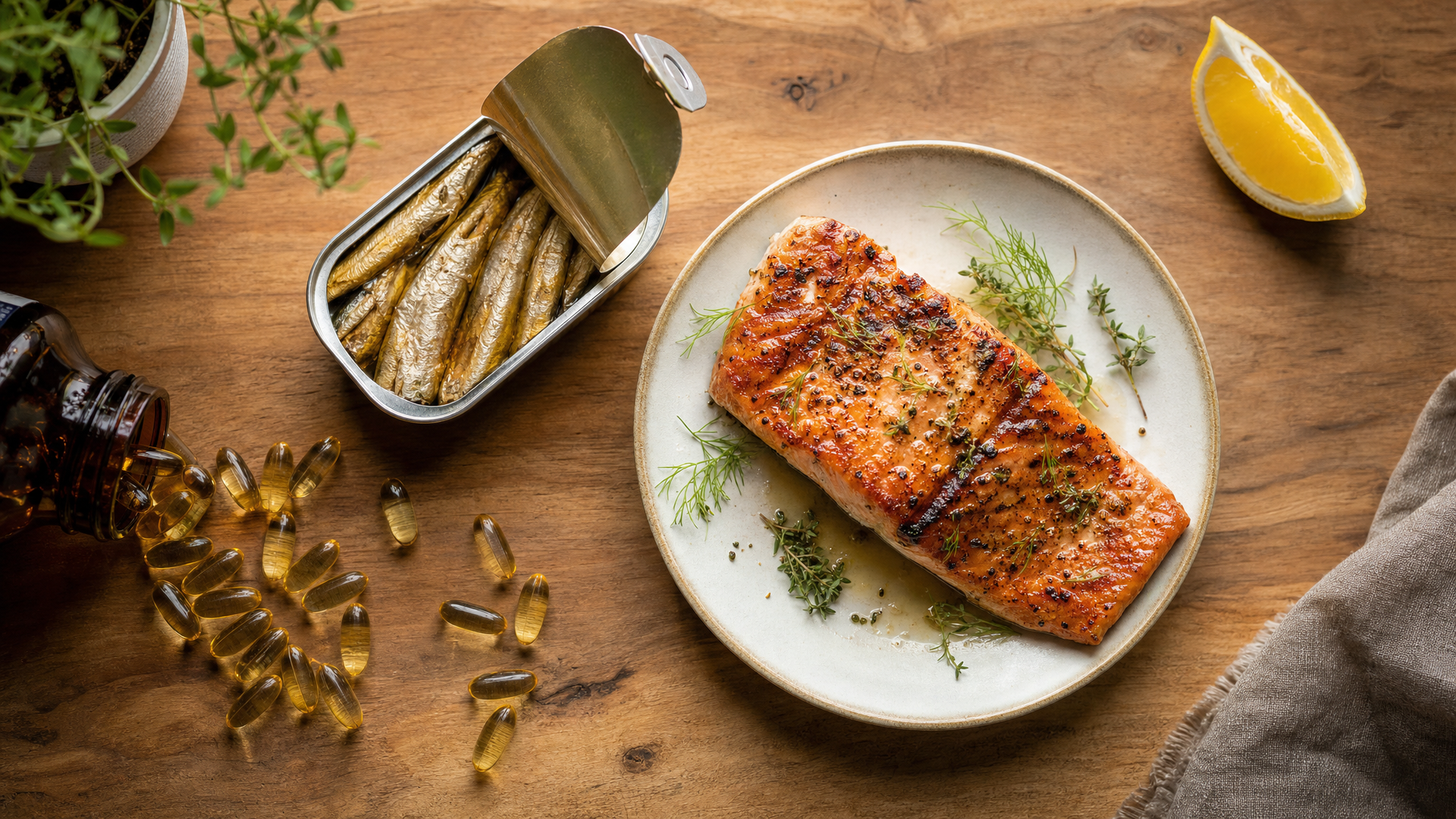
Walk into any gym locker room and you'll find a hundred guys with a tub of creatine, a bag of whey, and maybe a pre-workout that costs more per serving than their lunch. Ask them about fish oil and you'll get a shrug. "My mum takes that for her joints."
Here's the thing: omega-3 is one of the few supplements where the muscle research is actually interesting — not "might work, needs more study" interesting, but "this changes how your muscle responds to protein" interesting. And it's cheap. Stupidly cheap if you get it from food.
The catch is that almost nobody takes enough of it. The bottle in your cupboard that says 1000mg fish oil is probably giving you a fifth of the dose that showed up in the studies. You're taking a placebo and paying for the privilege.
Let's fix that.
- Omega-3 doesn't build muscle directly — it makes your muscle more responsive to the protein you already eat
- The number that matters is combined EPA plus DHA, not total fish oil
- Target 2-3g of EPA plus DHA per day, which is 4-6 standard capsules, not one
- Effects take 8-12 weeks because omega-3 has to physically build into your muscle cell membranes
- Two tins of sardines or mackerel a week gets you most of the way there for less than the cost of capsules
- Skip it if you already eat oily fish 3-4 times a week — you're covered
What Omega-3 Actually Is (And Why Most of It Doesn't Count)
Omega-3 is a family, not a single thing. Three members matter:
ALA (alpha-linolenic acid) comes from plants — flaxseed, chia, walnuts, rapeseed oil. Your body can convert it into the useful stuff, but the conversion rate is terrible. Somewhere between 2% and 10% for EPA, and under 1% for DHA in most men. Eating 1 oz of walnuts is good for you, but it is not an omega-3 strategy.
EPA (eicosapentaenoic acid) is the anti-inflammatory workhorse. Most of the recovery and soreness research points here.
DHA (docosahexaenoic acid) is structural. It gets built into cell membranes — brain, eyes, and yes, muscle fibres.
When someone says "omega-3 helps with X," they almost always mean EPA and DHA. Those come from oily fish and algae. That's it. Your flax smoothie doesn't count, your "omega-3 enriched" eggs contribute a rounding error, and the fish oil capsule that says 1000mg on the front is mostly other fats.
The enzyme that converts ALA to EPA is the same one competing with omega-6 fats from seed oils. A typical Western diet is flooded with omega-6, so that conversion pathway is jammed before your flaxseed even shows up. Eating more ALA doesn't fix the bottleneck.
The Muscle Case: Omega-3 Makes Protein Work Harder
This is the part that should interest you if you're trying to gain weight.
When you eat protein, your muscle turns on protein synthesis for a few hours. How strongly it turns on depends on the dose, the leucine content, and — this is the interesting bit — how sensitive the machinery is in the first place.
Several controlled trials have fed people a fixed dose of amino acids or protein, measured the muscle protein synthesis response, then supplemented them with fish oil for 8 weeks and repeated the test. The finding that keeps showing up: the same protein dose produces a larger synthesis response after omega-3 supplementation. Not because the protein changed. Because the muscle got more responsive to it.
The proposed mechanism is straightforward. EPA and DHA physically incorporate into the phospholipid membranes of your muscle cells, changing membrane fluidity and how signalling proteins behave. Downstream, the mTOR pathway — the one leucine flips on — appears to fire harder.
What that means for a hardgainer
You're already struggling to eat. If you're a 145 lb guy trying to hit 0.7-1.0g per lb of protein a day, you're forcing down a lot of chicken. Anything that makes that protein more effective is worth two quid a week.
This doesn't mean omega-3 replaces protein. It means the protein you're already choking down does slightly more. Small edge, compounded over a 18 lb bulk, on top of a supplement that costs less than a single pre-workout.
Don't expect this to feel like anything. You won't get a pump from fish oil. The effect shows up on a muscle biopsy and a body composition scan over months, not in the mirror next Tuesday.
Recovery and Soreness: The More Reliable Effect
The muscle protein synthesis research is promising but the trials are small. The soreness research is broader and more consistent.
Across a decent pile of studies, omega-3 supplementation reduces delayed onset muscle soreness after damaging exercise — eccentric work, novel exercises, high-volume sessions. Markers of muscle damage like creatine kinase also come down, and subjective soreness ratings drop by a meaningful margin in the 24-72 hour window.
Why does this matter when you're bulking? Because soreness quietly wrecks your appetite and your training frequency. When your legs are trashed on a Wednesday, you skip Thursday's session, you eat less because you're lying on the sofa, and your weekly volume drops. Less training stimulus plus fewer calories equals no gains.
If you want the full picture on eating for recovery, we've covered what actually speeds up recovery between sessions in detail. Fish oil is one piece of that, not the whole thing.
The soreness benefit only shows up if you've been supplementing for weeks before the session that wrecks you. Taking fish oil the morning after leg day does nothing. It's a chronic intervention, not a painkiller.
The Dose Nobody Takes
Here's where almost everyone gets it wrong.
The studies showing muscle and recovery benefits used roughly 2-3g of combined EPA plus DHA per day. Some used more. A handful of the muscle protein synthesis trials sat around 3.5g.
Now go look at a standard drugstore fish oil capsule. 1000mg fish oil on the front. Flip it over: 180mg EPA, 120mg DHA. That's 300mg of the stuff that matters per capsule.
To hit 2.5g of EPA plus DHA from that bottle you'd need to swallow eight capsules a day. Most people take one. Some take two because they're being thorough. That's 300-600mg — roughly a fifth of the effective dose.
A rough way to scale it
Bodyweight scaling isn't well established here, but a sensible rule of thumb is around 16-18mg per lb of bodyweight. That lands a 132 lb guy near 2.2g and a 200 lb guy near 3.3g. If you're somewhere in the middle, 2.5g a day is a clean target.
Don't overthink the decimal. The difference between 2.2g and 2.8g is noise. The difference between 0.3g and 2.5g is the entire effect.
EPA plus DHA, 2-3 grams daily. If a label doesn't let you calculate that number in under ten seconds, put it back on the shelf.
How to Read the Back of the Bottle
Front-of-bottle marketing is designed to confuse you. Here's the three-step check.
Step 1: Find EPA and DHA in milligrams. Not "omega-3 complex," not "marine lipid concentrate," not "total omega-3" (which sneaks in DPA and ALA to inflate the number). Just EPA and DHA. Add them together.
Step 2: Check the serving size. This is the classic trick. The panel says 800mg EPA plus DHA and you think brilliant, three capsules a day. Then you spot "Serving size: 3 softgels." You're back to 267mg each. Always divide by the capsule count.
Step 3: Do the daily maths. Take your target of 2500mg, divide by the EPA plus DHA per capsule, and that's how many you swallow. If that number is above six, the product is too weak to be practical and you should buy a concentrate instead.
What a good label looks like
| Product type | EPA + DHA per capsule | Capsules for 2.5g/day |
|---|---|---|
| Bargain drugstore fish oil | 300mg | 8 |
| Standard supermarket brand | 500mg | 5 |
| Concentrated triglyceride form | 800-900mg | 3 |
| High-strength liquid (1 tsp) | 1500-2000mg | 1-2 tsp |
Concentrates cost more per capsule and less per gram of actual omega-3. That's the only ratio worth comparing.
Triglyceride vs ethyl ester
You'll see these terms on premium bottles. Ethyl ester is the cheaper processing form; re-esterified triglyceride absorbs somewhat better and resists oxidation slightly longer. The absorption difference is real but modest — maybe 20-30% in some studies.
Honestly? Don't pay double for it. Take a bit more of the cheap one and you've closed the gap for less money. Where the form does matter is rancidity, which brings us to the thing nobody checks.
Fish oil oxidises. Independent testing has repeatedly found a meaningful chunk of retail products exceeding oxidation limits before the expiry date. Bite one capsule open — if it tastes sharp, bitter, or like the bin behind a chip shop, the whole bottle is oxidised. Return it. Rancid oil isn't just useless, it's actively pro-inflammatory, which is the exact opposite of why you bought it.
Store the bottle in the fridge, buy smaller bottles you'll finish in two months, and prefer products with added vitamin E as an antioxidant.
The Food Route: Two Tins a Week
If you'd rather spend your money on groceries than capsules — and for a lot of skinny guys on a budget, that's the right call — oily fish does the job better than supplements do. You get the EPA and DHA plus protein, selenium, iodine, vitamin D, and B12.
Here's what different fish actually deliver. Portion sizes are listed both ways.
| Fish (cooked or drained) | Portion | EPA + DHA |
|---|---|---|
| Mackerel | 150g / 5 oz | 2500-3000mg |
| Sardines, canned in oil | 100g / 3.5 oz tin | 1400-1800mg |
| Salmon, farmed | 150g / 5 oz | 2000-2500mg |
| Salmon, canned pink | 100g / 3.5 oz | 1000-1400mg |
| Herring | 100g / 3.5 oz | 1500-2000mg |
| Trout | 150g / 5 oz | 1000-1300mg |
| Tuna, canned in brine | 100g / 3.5 oz | 200-300mg |
| Cod | 150g / 5 oz | 200-300mg |
Two things jump out. First, canned tuna is not an omega-3 food. It's a lean protein source. The canning process and the species both work against you. Second, the cheapest fish on that list — sardines and mackerel — are also the best.
The sardine maths
A 3.5 oz tin of sardines costs less than a coffee, packs about 1600mg of EPA plus DHA, and gives you roughly 22-25g of protein and 200-250 calories depending on whether it's packed in oil or water. Buy the oil. You're bulking, you need the calories, and the oil-packed version protects the omega-3 better.
Eat two tins across a week and you're averaging around 450mg a day. Add a 5 oz mackerel fillet on a Sunday and you're at roughly 850mg a day averaged out. Three to four oily fish servings a week — call it 14-18 oz of oily fish total — puts you comfortably in the 1-1.5g daily range.
That's not the full 2.5g from the studies, but it's five times what most guys get, and it comes with a pile of micronutrients a capsule can't give you. If you want to top up to the research dose, take two or three capsules on non-fish days and call it done.
Mash a tin with a fork, add lemon juice, black pepper, and a spoon of mayo or Greek yoghurt. Spread it on toast with hot sauce. It's a 500-calorie meal that takes ninety seconds and tastes like a proper lunch rather than a punishment. Mackerel in tomato sauce over rice works the same way.
Mercury, since someone will ask
Small oily fish — sardines, mackerel, herring, anchovies — sit low on the food chain and accumulate very little mercury. You can eat them daily without concern. The fish to moderate are the big predators: swordfish, king mackerel, shark, and large tuna. Nobody's bulking on swordfish, so this is a non-issue in practice.
When to Take It and What to Expect
Take it with a meal containing fat. Omega-3 is fat-soluble and absorption improves substantially with a real meal. Taking capsules on an empty stomach is the fastest route to fishy burps and wasted money.
Split the dose. Four to six capsules at once is rough on the stomach. Two with breakfast and three with dinner goes down easier.
Timing around training doesn't matter. This is a chronic membrane-level effect. There's no anabolic window for fish oil.
Give it 8-12 weeks. Omega-3 has to physically incorporate into your cell membranes, and that process takes months. Most of the trials that found benefits ran for 8 weeks or longer. If you take it for two weeks, notice nothing, and quit, you never actually ran the experiment.
Freeze the capsules if you burp. Frozen softgels pass the stomach before dissolving. Cheap fix, works almost every time.
Who Should Skip This
I'd rather you spend your money well than buy something you don't need.
Skip it if you already eat oily fish three or four times a week. You're getting more omega-3 from food than most supplements provide, along with better nutrient density. Adding capsules on top is redundant.
Be cautious if you're on blood thinners. High-dose omega-3 has a mild antiplatelet effect. At 2-3g daily this is not a practical concern for healthy people, but if you're on warfarin or similar, talk to your doctor first. Same goes for the week before surgery.
Deprioritise it if your basics are broken. If you're not hitting your calories, not hitting your protein, and training twice a week, fish oil is the least of your problems. Supplements are the last 5%. Fix the 95% first — we ranked which supplements are actually worth buying while bulking so you can see where omega-3 lands relative to creatine and whey.
Four Mistakes That Waste Your Money
1. Counting "1000mg fish oil" as 1000mg of omega-3. It's usually 300mg. This single misunderstanding is why the supplement has a reputation for doing nothing — almost everyone testing it on themselves is taking a fifth of the dose.
2. Buying a huge value tub. A 400-capsule jar at your dose lasts three months, and it'll be oxidising the whole time once opened. Buy smaller, buy fresher, keep it cold.
3. Relying on flax, chia, or walnuts. They're good foods. They are not EPA and DHA sources. If you're vegetarian or vegan, buy an algae oil supplement — that's where the fish get it from originally, and it delivers real EPA and DHA at comparable doses.
4. Treating it as a standalone fix. Omega-3 is one nutrient among many that skinny guys under-eat while bulking. Zinc, magnesium, vitamin D and iron are just as commonly short, and the deficiencies stack. We went through the micronutrients that quietly stall gains if you want to audit the rest of your diet properly.
Where FuelTheGains Comes In
Here's the honest problem with everything above: knowing you should eat oily fish three times a week is easy. Actually building that into a bulking week — while hitting 0.8g per lb, landing on a calorie surplus that grows you at 0.5-0.9 lb a week, and not eating the same three meals until you hate food — is the hard part.
That's what we built for. You put in your bodyweight, your training days and what you'll actually eat, and it builds a weekly bulking plan around it — with oily fish worked into the rotation rather than bolted on as a supplement you'll forget about. Sardines on toast on a Tuesday, mackerel and rice on a Sunday, macros already counted.
You don't need an app to eat a tin of sardines. But if the reason your diet keeps collapsing is that planning it takes more effort than cooking it, that's exactly the problem it solves.
The Bottom Line
Fish oil isn't magic and it won't add 11 lb to your frame. What it does is make the protein you're already forcing down slightly more effective, and make the training you're already doing slightly easier to recover from. Over a full bulk, that's a real edge for pocket change.
Just take the actual dose. 2-3 grams of combined EPA plus DHA, read off the back of the bottle, not the front. Or eat two tins of sardines and a mackerel fillet each week and skip the capsules entirely.
The cheapest supplement in the shop is the one nobody bothers to dose correctly. Be the exception.