
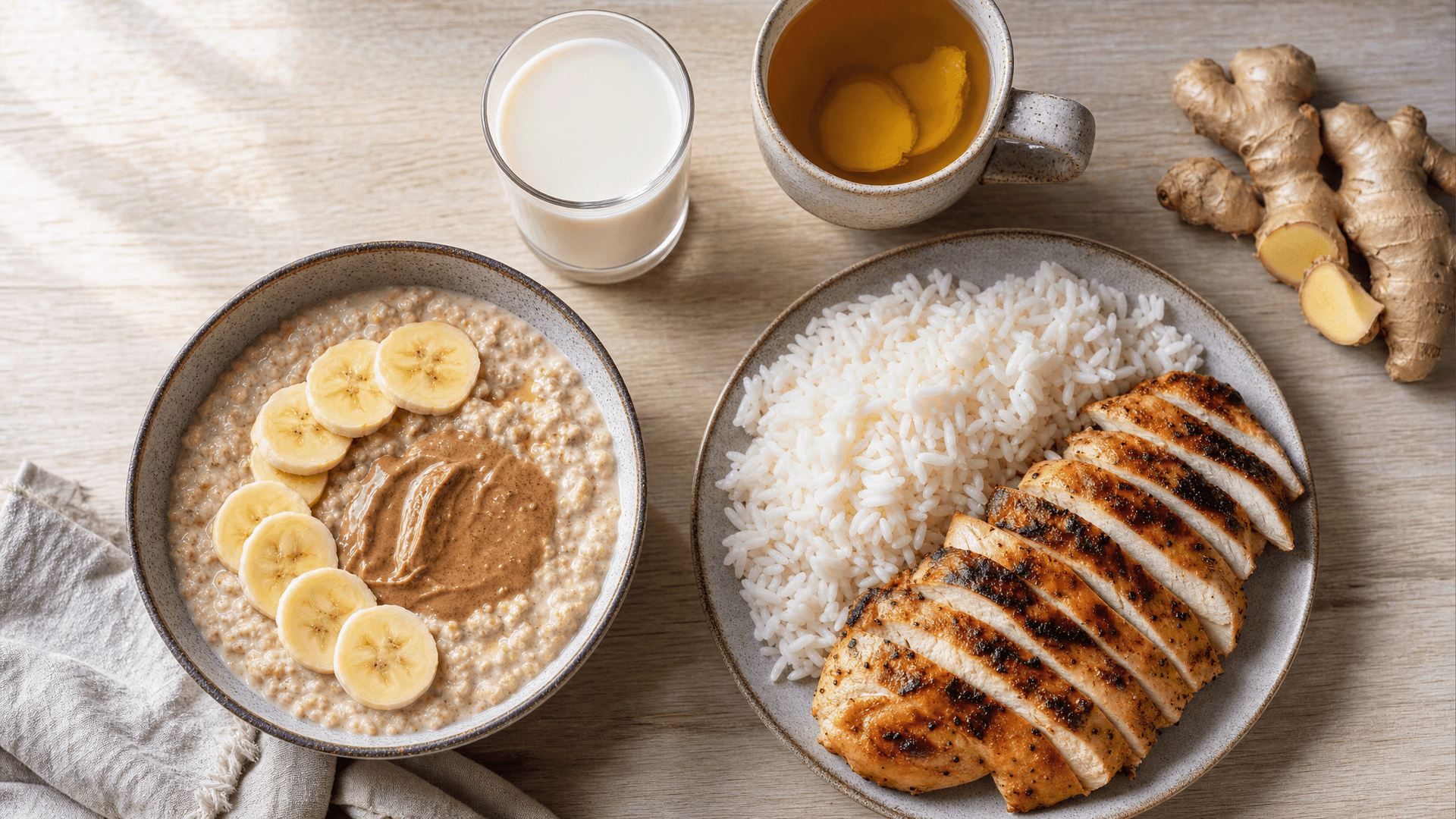
You finally started eating like you mean it. Four solid meals, a shake before bed, peanut butter on everything. The scale is moving.
And then the burning starts. That sour taste creeping up your throat while you're lying in bed. The tightness in your chest at 2am that makes you sit up and wonder if something is seriously wrong.
So you do the obvious thing: you eat less at once. Smaller plates. Skip the bedtime shake. Cut the pasta. And within three weeks the scale stops moving, because you just quietly deleted 600 calories a day from your diet without noticing.
Here's what nobody tells you — "eat less" is not the only option. Reflux is mostly a mechanics problem, not a volume problem. Fix the mechanics and you can keep the surplus.
- Reflux on a bulk is usually about meal size, fat content and timing — not total calories
- Spread the same calories over 5-6 smaller feedings instead of 3-4 huge ones
- Stop eating solid food 3 hours before bed, and sleep on your left side with your head elevated
- Swap the worst offenders: tomato sauce, chocolate gainers, coffee on an empty stomach, mint, carbonated drinks
- Liquid calories sit lower and empty faster than solid food — use them strategically, not at bedtime
- Losing 300 calories a day to heartburn costs you roughly 1 kg of gains every two months
Why Bulking Is Basically a Reflux Machine
There's a muscle at the bottom of your esophagus called the lower esophageal sphincter. Its whole job is to stay shut so stomach acid stays in your stomach. Reflux happens when it opens when it shouldn't, or when pressure in your stomach gets high enough to force it.
Now look at what a bulk actually does to you:
You raise stomach pressure. A 1,200-calorie meal physically distends your stomach. The more volume in there, the more upward pressure on that sphincter. This is why the burning almost always shows up after the biggest meal of the day, not the smallest.
You eat way more fat. Fat is the calorie-dense tool every hardgainer reaches for — oils, nut butters, cheese, whole milk, fatty cuts. But fat slows gastric emptying dramatically. A high-fat meal can sit in your stomach for 4 to 5 hours versus 2 for a lean one. That's hours of extra time for acid to find its way up. Fat also relaxes that sphincter directly.
Your stomach is never empty. Eating every 2.5 hours is standard hardgainer advice, and it works for calories. But it means you never get the natural clearing periods a normal eating pattern gives you.
You eat right before bed. Bedtime calories are genuinely useful for muscle growth, but horizontal plus full stomach is the single worst position for reflux. Gravity was doing half the work of keeping acid down, and you just removed it.
You lift heavy. Squats, deadlifts and anything requiring a braced core spike intra-abdominal pressure hard. Train 90 minutes after a big meal and you're essentially squeezing your stomach like a tube of toothpaste.
None of those five things means you have to eat less. Every one of them has a workaround.
If you're getting reflux most days, waking up choking, having trouble swallowing, losing weight without trying, or seeing anything dark in your stool — stop self-managing and go see a doctor. Chronic untreated reflux damages your esophagus, and a few of those symptoms can point to something that isn't reflux at all. This article is about optimizing a bulk around mild, food-triggered heartburn, not diagnosing you.
The Real Cost of Shrinking Your Portions
Most guys underestimate how much a "let me just eat a bit less" adjustment costs them.
Say you're eating 3,500 calories to gain. Heartburn makes you skip the bedtime shake (550 calories) and eat two-thirds of your dinner instead of all of it (-250 calories). You're now at 2,700 — which for a lot of lifters is barely maintenance.
At a 500-calorie daily surplus you'd expect roughly 0.5-0.9 lb of gain per week. Kill that surplus and you gain nothing. Over two months, that's about 4-7 lb of bodyweight you simply didn't build.
That's the trade most people make without doing the math. They treat heartburn as a signal to eat less, when it's actually a signal to eat differently.
Fix 1: Restructure Meal Size, Not Meal Total
This is the highest-leverage change and it's boring: take the same calories and divide them into more, smaller pieces.
Here's what that looks like at 3,500 calories:
| Structure | Meals | Calories per feeding | Reflux risk |
|---|---|---|---|
| Classic 3-meal | 3 | ~1,170 | High |
| Standard bulk | 4 + shake | ~700 | Moderate |
| Reflux-friendly | 6 | ~580 | Low |
The difference between a 1,170-calorie sitting and a 580-calorie sitting is enormous in terms of stomach distension. Same daily total, roughly half the peak pressure.
Practically:
- Cap solid meals at around 700 calories. If a meal is getting bigger than that, split it and eat the second half 90 minutes later.
- Eat slowly. Twenty minutes minimum per meal. Eating fast means more air swallowed and a faster pressure spike. This one is free and most people ignore it.
- Don't drink a liter of water with your food. Fluid adds volume. Sip during, hydrate between meals.
- Stay upright for 45-60 minutes after eating. Walk, do dishes, stand at your desk. Do not lie on the couch.
If eating more often sounds impossible because you're never hungry in the first place, that's its own problem worth solving — our guide on how to eat more when you're not hungry covers the appetite side, and the two fixes stack well. Smaller meals are actually easier to force down.
Set three alarms on your phone at fixed times for the "extra" feedings — mid-morning, mid-afternoon, and 3 hours before bed. Reflux-friendly eating only works if it's scheduled. Left to hunger, you'll end up back at two giant meals.
Fix 2: Move Your Fat Around
You can't bulk on lean chicken and rice alone — you need fat for the calorie density. But when you eat that fat matters as much as how much.
The rule: front-load fat, taper it toward bedtime.
Your breakfast and lunch can carry the heavy stuff — 1.5 oz of peanut butter, whole eggs, olive oil, full-fat cheese. You've got 10+ hours of upright time ahead to clear it.
Dinner and anything after should shift toward lean protein and carbs, which empty out of your stomach much faster. Chicken breast, white fish, lean beef, rice, potatoes, pasta with an oil-free sauce.
Here's a rough fat distribution for a 3,500-calorie day at 120g total fat:
| Meal | Time | Fat | Notes |
|---|---|---|---|
| Breakfast | 7:00 | 35g | Eggs, nut butter, whole milk |
| Snack | 10:00 | 20g | Nuts, cheese |
| Lunch | 13:00 | 35g | Fatty cut, oil dressing |
| Snack | 16:00 | 15g | Yogurt, a little granola |
| Dinner | 19:00 | 12g | Lean protein + big carbs |
| Bedtime | 21:30 | 3g | Lean liquid protein |
Same 120g of fat. Wildly different night.
The specific fat swaps that help most
- Fried anything → baked or pan-seared with minimal oil, at dinner specifically. Deep-fried food is the single most reliable reflux trigger in most studies.
- Cream-based sauce → broth or stock-based for the evening meal.
- Full-fat milk in the bedtime shake → skim or lactose-free skim. You lose about 80 calories per 17 oz; make it back at breakfast.
- Fatty ground beef at dinner → leaner ground beef plus a bigger portion of rice. Calories stay, gastric emptying speeds up.
Fix 3: Know Which Bulking Staples Are Actually Triggering You
Some of the most common hardgainer foods are notorious reflux triggers. Not all of them will hit you — trigger foods are genuinely individual — but these are the ones worth testing first.
| Common bulking food | Why it triggers | Swap |
|---|---|---|
| Coffee on an empty stomach | Acidic, relaxes the sphincter, stimulates acid with nothing to buffer it | Same coffee, but after food. Or switch to a lower-acid dark roast |
| Tomato-heavy pasta | Naturally acidic, and you eat a big volume of it | Pesto, olive-oil-and-garlic, or a cream-free white sauce |
| Chocolate mass gainers | Cocoa contains methylxanthines that relax the sphincter | Vanilla or unflavored gainer |
| Giant pre-bed shake | Volume + lying down | Same calories, 3 hours earlier, thinner consistency |
| Carbonated drinks | The gas itself raises stomach pressure | Flat water, milk, juice |
| Citrus juice | Directly acidic | Apple, pear, or watermelon juice — similar calories |
| Peppermint tea | Relaxes the sphincter, despite the "good for digestion" reputation | Ginger or chamomile |
| Raw onion and garlic | Common individual trigger | Cooked versions are usually fine |
| Spicy sauces on everything | Irritates an already inflamed esophagus | Herbs, cumin, paprika, smoked salt |
| Alcohol | Relaxes the sphincter and increases acid | Cut it on training blocks, honestly |
The coffee one deserves its own note because it's so common. Black coffee on an empty stomach at 6:30am, then training fasted, then a huge post-workout meal — that sequence is a reflux special. Eat something first, even 5 oz of milk or a banana. It costs you nothing and often solves the morning burn on its own.
Don't cut all ten at once. Remove one suspected trigger for 5 days, note whether the symptoms change, then reintroduce it. Cutting everything simultaneously teaches you nothing and usually ends with a diet so boring you quit the bulk entirely.
Fix 4: Sort Out Your Nights
The bedtime window is where most bulkers get destroyed, and it's also where the easiest wins are.
Stop solid food 3 hours before you lie down. This is the single most effective non-drug intervention for nighttime reflux. If you sleep at 23:00, last solid meal at 20:00.
Elevate the head of your bed by 6-8 inches. Not more pillows — that bends you at the waist and increases abdominal pressure, which makes things worse. Put blocks under the bed legs at the head end, or get a wedge that goes under the mattress so your whole torso is on an incline.
Sleep on your left side. Your stomach sits to the left, and in that position the junction with the esophagus is above the level of the acid. Right-side sleeping puts it below. This sounds like folklore and it's one of the better-supported positional findings out there.
Now — bedtime protein genuinely helps overnight muscle protein synthesis, and I'm not telling you to skip it. You just need it in a form that doesn't sit in your stomach. Our breakdown of the best bedtime snacks for muscle growth gets into the options; the reflux-friendly version of that list looks like this:
Bedtime options ranked by reflux risk
| Option | Calories | Reflux risk |
|---|---|---|
| Casein or whey in water | 130 | Very low |
| Skim milk + protein powder | 220 | Low |
| Low-fat Greek yogurt | 180 | Low |
| Whole milk + oats + peanut butter | 600 | High |
| Cottage cheese with full-fat cream | 450 | High |
| Pizza (be honest) | 800 | Nightmare |
If you're currently getting 550-600 calories from a bedtime shake, don't just delete it — move those calories to a fifth feeding at 17:00 or 18:00 and keep a small, lean protein hit at night. You keep the overnight amino acids and lose the 3am burning.
A thinner shake refluxes less than a thick one at the same calories. Blending 10 oz of skim milk with protein powder and a little honey empties faster than the same calories as a thick oats-and-nut-butter slurry. Counterintuitive, but volume that leaves your stomach fast is volume that can't come back up.
Fix 5: Time Your Training Around Your Stomach
Bracing for heavy compounds compresses your abdomen on purpose. That's fine. It's just a terrible thing to do with 28 oz of food in your stomach.
- Leave 2-3 hours between a full solid meal and heavy squats or deadlifts. If you can't, make the pre-training meal liquid and lean.
- Pre-workout fuel that works with reflux: a shake with skim milk, a banana, rice cakes with honey, or simply 2 oz of oats made with water and a scoop of protein. Low fat, low fiber, low volume.
- Post-workout is your best big-meal window. You're upright, you're active, gastric emptying is normal, and you've got hours before bed. Put the biggest plate of the day here.
- Skip the belt on lighter accessory work if you're symptomatic — a tight belt on a full stomach is just added pressure.
- Careful with pre-workout powders. High caffeine plus citric acid plus an empty stomach is a triple hit. If your pre-workout burns going down, it's burning on the way back up too.
Fix 6: The Boring Lifestyle Stuff That Moves the Needle
These aren't nutrition tips, but they matter more than most food swaps.
Chew gum after meals. Non-mint gum for 30 minutes after eating increases saliva, which is alkaline and helps clear acid from the esophagus. It's cheap, it's easy, and the effect is real.
Don't wear a tight belt or tight waistband while you're eating big. Sounds trivial. Isn't. Anything compressing your midsection raises pressure on the sphincter.
Watch your stress and sleep. Both increase acid sensitivity and slow gastric emptying. A bulk during a brutal exam period or a 5-hours-of-sleep phase will reflux more than the same diet on a calm month.
If you smoke or vape, nicotine directly relaxes the lower esophageal sphincter. This is probably the biggest single non-food factor if it applies to you.
Antacids are a tool, not a strategy. An occasional calcium carbonate tablet after an unusually big meal is fine. If you're taking them daily to keep eating the way you're eating, that's a sign the structure needs fixing, and it's a conversation for your doctor — long-term acid suppression has its own considerations, including effects on protein digestion and mineral absorption that actually matter to a lifter.
A Full Reflux-Friendly 3,500-Calorie Day
Here's what all six fixes look like combined. Adjust portions to your own numbers — this is a template, not a prescription.
07:00 — Breakfast (700 cal)
- 3 whole eggs + 2 egg whites, pan-cooked with a little olive oil
- 2 slices sourdough
- 1 oz peanut butter
- 8 oz whole milk
Coffee after this, not before.
10:00 — Snack (450 cal)
- 1.4 oz mixed nuts
- 1 banana
- 7 oz low-fat Greek yogurt
13:00 — Lunch (750 cal)
- 6 oz chicken thigh
- 9 oz cooked rice
- Roasted vegetables, olive oil
- Avocado, half
16:00 — Pre-training (400 cal)
- 2 oz oats with water
- 1 scoop whey
- Honey
Train at 17:30.
19:00 — Dinner, the big one (900 cal)
- 8 oz lean ground beef
- 10.5 oz pasta, cooked, with pesto or olive-oil-and-garlic — not tomato
- Green salad, light vinaigrette
- 1.4 oz parmesan
20:45 — Bedtime (300 cal)
- 1 scoop casein in 10 oz skim milk
- 1 tbsp honey
Sleep at 23:00. That's 3,500 calories, roughly 200g protein, and the last solid food is more than 3 hours before you're horizontal.
When Reflux Isn't Actually Reflux
Worth flagging, because bulkers confuse these constantly:
Bloating and fullness aren't reflux. If your problem is mostly pressure, gas and feeling stuffed rather than burning in your chest, you're probably dealing with a fiber, FODMAP or eating-speed issue instead. Different fix — start with our guide on fixing digestion problems while bulking, which covers the bloating side in detail.
Lactose intolerance can look like reflux. If milk-heavy days are the bad days, test lactose-free milk for a week before you blame acid. Plenty of guys drinking 50 oz of milk a day are fighting lactose, not a sphincter.
Whey specifically bothers some people. Try a different protein — micellar casein, a blend, or an isolate with no gums and no sucralose. Sweeteners and thickeners in cheap powders are underrated troublemakers.
Exercise-induced symptoms can come from breathing patterns, not food, especially during conditioning work. If your burn only shows up on hard cardio and never after meals, food swaps won't fix it.
Where FuelTheGains Fits
The annoying part of all this isn't the knowledge — it's the arithmetic. Splitting 3,500 calories into six feedings, keeping 80% of your fat before 14:00, hitting your protein, and making sure the evening meals stay lean while the day still adds up? That's a spreadsheet problem, and most people give up on it by day four.
That's what we built for. You tell it your calorie target and your constraints — how many meals you want, which foods you can't tolerate, how late you eat — and it builds the plan and the grocery list around them. If tomato sauce, chocolate, and anything fried after 18:00 are off the table, it plans around all three and still gets you to your surplus.
No guessing whether tonight's dinner is going to cost you sleep, and no quietly losing 500 calories a day because it was the easiest way to stop the burning.
The Bottom Line
Heartburn on a bulk feels like your body telling you to eat less. It's usually telling you to eat the same amount with better mechanics — smaller feedings, fat earlier in the day, a 3-hour gap before bed, and a handful of specific swaps.
Try the structure for two weeks before you touch your calorie target. Split the meals, move the fat forward, get the bedtime shake off your chest and into an afternoon feeding, and raise the head of your bed.
Most guys find the burning drops off sharply and the scale keeps moving. That's the whole point — you shouldn't have to pick between building muscle and sleeping through the night.