
You go in for a routine physical. Nothing dramatic — your job wants it, or your mom nagged you, or you finally got around to it.
Two weeks later the results land in your inbox. LDL: 148. Triglycerides: 195. ALT: 62. Blood pressure: 138 over 84. Three little flags next to three numbers you've never thought about in your life.
And your first thought is: the bulk did this.
So you panic. You cut back to 2,400 calories, you throw out the whole milk, you swap your ground beef for chicken breast and your peanut butter for nothing at all. Six months of hard-won weight quietly disappears, and you're back to being the skinny guy who can't fill out a t-shirt.
Here's the thing nobody tells you: some of those numbers were never a problem, and the ones that were are fixable without touching your calorie target.
Eating in a surplus genuinely changes your blood chemistry. That's not paranoia. But how it changes them depends almost entirely on what your surplus is made of, when you got tested, and what you did in the 72 hours before the needle went in. A 24-year-old gaining 1 lb a week on real food has a completely different risk picture than a 55-year-old with the same lipid panel and a desk job.
Let's break down what actually moves, what's noise, and what to change.
- A calorie surplus reliably raises triglycerides and can nudge LDL up — this is expected, not disease
- Elevated ALT and AST are often just muscle damage from lifting, not liver damage
- Bad prep ruins the test: alcohol, a heavy meal, or a leg day within 72 hours will distort your results
- Fiber and fat source fix most lipid problems without cutting a single calorie
- Sodium creep from processed bulk foods is the most common cause of a flagged blood pressure reading
- Get a baseline before your bulk so you can tell a real trend from a one-off snapshot
This is a practical guide, not medical advice. If a marker comes back flagged, talk to your doctor — and take this article with you so you can have a smarter conversation than "I eat a lot."
What Actually Changes When You Eat 4,000 Calories a Day
A surplus isn't just extra fuel sitting in a tank. It's a metabolic state. Your body is constantly processing, packaging and shipping nutrients, and that shows up in your bloodstream.
Here's the honest breakdown of what shifts and how much.
Triglycerides — the one that moves the most
Triglycerides are circulating fat. When you eat a lot — especially a lot of carbs and fat together — your liver packages the excess into VLDL particles and ships them out. More food in means more of them floating around.
This is the marker most sensitive to a surplus. A guy eating 2,200 calories with triglycerides at 85 can easily read 160-190 on 4,000 calories, without anything being wrong with him.
It's also the marker most sensitive to when you ate. Triglycerides can swing 30-50% between a properly fasted draw and a sloppy one. More on that shortly.
LDL — moves less than you'd think
LDL cholesterol responds mostly to saturated fat intake and body fat levels, not raw calories. If your surplus came from olive oil, nuts, oily fish and oats, your LDL might not move at all. If it came from butter, fatty red meat, cheese and ice cream, expect it to climb 10-25 points.
The number that actually predicts risk is ApoB — the count of atherogenic particles rather than the cholesterol inside them. It's cheap, it's more accurate, and almost no doctor orders it unless you ask. Ask.
HDL — usually goes up, and that's good
Here's some free good news: consistent resistance training and adequate healthy fat intake tend to raise HDL. Lifters usually have better HDL than sedentary people at the same body fat. If your HDL is 55+ and climbing, that's your training working.
Blood pressure — the sneaky one
This one rarely gets blamed on bulking, but it should. Not because of calories — because of sodium. When you go from 2,500 to 4,000 calories, sodium intake often goes up 50-80% just by volume of food. Add in bulk-friendly processed stuff (deli meat, canned soup, frozen pizza, protein bars, sauces) and you can hit 5,000mg a day without noticing.
Some people are salt-sensitive. If you're one of them, that's a 10-15 point systolic bump right there.
Liver enzymes — mostly a lifting artifact
ALT and AST are the enzymes doctors use to check for liver stress. Here's what almost nobody mentions: AST is also released by skeletal muscle. So is ALT, to a lesser degree. Hard training — especially heavy eccentrics, a new program, or a deadlift session — can elevate both for days.
A study population of untrained people doing one hard resistance session showed AST climbing well past the "normal" ceiling for up to a week. That's not liver damage. That's your quads.
Fasting glucose and A1c
Usually stable or slightly improved in a lifting bulk, because muscle is a glucose sink. If your fasting glucose is creeping up while you're gaining, that's a signal your surplus is too aggressive or too refined-carb heavy — worth flagging.
Normal vs. Actually Concerning
This is the table I wish someone had handed me at 24. "Flagged" and "dangerous" are not the same word.
| Marker | Standard reference | Common in a lifter bulking | Genuinely worth acting on |
|---|---|---|---|
| Triglycerides (mg/dL) | Under 150 | 120-190 | Above 200 fasted, twice |
| LDL-C (mg/dL) | Under 100 optimal | 100-140 | Above 160, or rising trend |
| ApoB (mg/dL) | Under 90 | 70-100 | Above 110 |
| HDL (mg/dL) | Above 40 | 50-70 | Below 40 |
| Systolic BP | Under 120 | 118-132 | 135+ on repeat readings |
| ALT (U/L) | Under 40 | 40-80 post-training | Above 80 when properly rested |
| AST (U/L) | Under 40 | 40-120 post-training | Elevated with rest + no lifting |
| Fasting glucose (mg/dL) | 70-99 | 80-95 | Above 100 repeatedly |
The pattern to notice: a single flagged value in isolation means very little. A trend across two or three tests, or a cluster of flagged values together, means something.
Lab values have natural biological variation of 10-20% week to week. If one number comes back slightly high, the correct move is to re-test in 8-12 weeks with better prep — not to overhaul your entire diet on the spot.
The Prep Mistakes That Fake a Bad Result
Half the scary blood panels I've seen from guys mid-bulk were partly self-inflicted. Not by the diet — by the 72 hours before the draw.
1. You weren't actually fasted
"Fasted" means 10-12 hours of water only. A protein shake at 11pm before an 8am draw is not fasted. Cream in your coffee is not fasted. Even a small meal 6 hours out can inflate triglycerides by 50 points or more.
2. You trained hard in the 48 hours before
This is the big one for liver markers. A heavy leg session on Wednesday and a blood draw on Thursday morning will give you ALT and AST numbers that look like hepatitis. Take 3 full days off lifting before any panel that includes liver enzymes. Yes, three. Your gains will survive it.
3. You drank
Alcohol hammers triglycerides and liver enzymes simultaneously. Two beers on Saturday can still be visible in a Monday panel. Give it 72 hours minimum.
4. You were dehydrated
Showing up dry — from a hot day, a sauna, or just not drinking — concentrates everything in your blood. Cholesterol, hematocrit, creatinine all read artificially high. Drink normally the day before and have water the morning of.
5. Creatine skewed your kidney markers
Creatine raises serum creatinine because it is a creatine byproduct. This makes your estimated kidney function (eGFR) look worse than it is. It's a measurement artifact, not kidney stress. Mention that you supplement it so your doctor doesn't chase a ghost.
Build a "clean test protocol" and use it every time: no alcohol for 72 hours, no lifting for 72 hours, normal food until 12 hours out, water only after, draw in the morning. Same protocol every test means your numbers are actually comparable over time.
The Fixes That Don't Cost You a Single Calorie
Here's the part that matters. Almost every lipid problem in a bulking lifter is a composition problem, not a quantity problem. You can fix the numbers and keep eating 4,000 calories.
Fix 1: Change your fat sources, not your fat intake
You need fat to bulk. It's 9 calories per gram — it's the only realistic way to get calorie-dense without eating until you feel sick. Don't cut it. Redistribute it.
Aim for roughly one-third saturated, two-thirds unsaturated instead of the reverse.
| Swap this | For this | Why |
|---|---|---|
| Butter on everything | Olive oil, avocado oil | Monounsaturated, LDL-neutral |
| 80/20 ground beef daily | 90/10 beef + olive oil | Same calories, less sat fat |
| Cheese as the main fat | Nuts and nut butters | Fiber + unsaturated fat |
| Cream in the shake | Whole milk + nut butter | Better fatty acid profile |
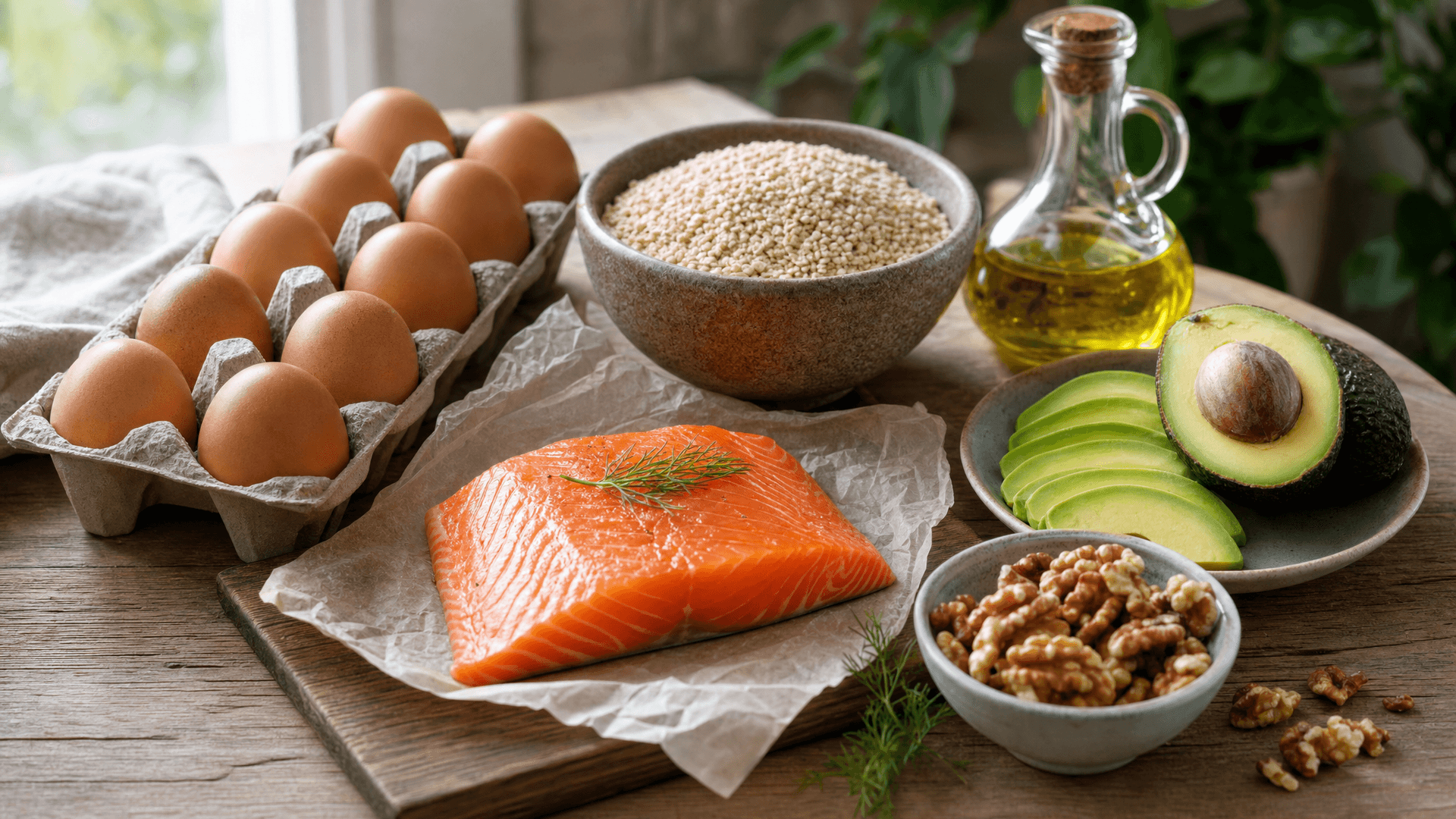
| Bacon every morning | Eggs + avocado | Fewer nitrates, more mono fat |
A concrete example: swapping 7 oz of 80/20 beef for 7 oz of 90/10 plus a tablespoon of olive oil keeps you at almost identical calories and drops about 8g of saturated fat. Do that four times a week and it's meaningful.
If you want the full breakdown of which fats are actually worth your calories, we went deep on it in the best fats for bulking.
Fix 2: Add oily fish twice a week
Omega-3s are the single most reliable dietary lever for triglycerides. Two servings of 5 oz salmon, mackerel or sardines per week can drop triglycerides 15-25%.
Salmon is also a great bulking food in its own right — 5 oz gives you roughly 320 calories and 34g protein with the fat built in.
If fish isn't happening, 1 oz of walnuts or 0.9 oz of chia seeds daily helps, though plant omega-3s convert less efficiently.
Fix 3: Actually eat fiber
This is the most neglected fix in all of bulking. Soluble fiber binds bile acids in your gut, forcing your liver to pull cholesterol out of circulation to make more. It directly lowers LDL.
Most bulking guys eat 12-15g of fiber a day because their diet is meat, rice, protein powder and white bread. Target 30-40g.
Easy high-calorie fiber sources that don't fill you up too much:
- Oats — 3.5 oz dry gives you 380 calories and 10g fiber
- Black beans — cheap, 15g fiber per cup, mixes into anything
- Chia seeds — 1 oz is 150 calories and 10g fiber
- Berries in your shake — negligible calorie cost, real fiber
- Whole grain bread instead of white — free swap
- Psyllium husk — a teaspoon in your shake, near-zero calories
Ramp fiber slowly. Going from 12g to 40g overnight will wreck your digestion and make eating big miserable for a week. Add 5g every few days.
Fix 4: Get your sodium under control
Not zero — you need sodium, especially training hard and sweating. But under 3,000mg a day is a reasonable ceiling, and most bulkers blow past it without trying.
The fix is boring and it works: cook more of your own food. The sodium isn't in your rice and chicken, it's in the sauce, the deli meat, the frozen meals and the seasoning blends.
Also worth knowing: potassium partly offsets sodium's effect on blood pressure. Potatoes, bananas, beans, yogurt and leafy greens all help. Most guys are eating too little potassium and too much sodium at the same time.
Fix 5: Don't gain too fast
This is where the dirty bulk vs clean bulk debate stops being about aesthetics and starts being about health markers.
Rapid fat gain — especially visceral fat around the organs — is what actually drives insulin resistance, elevated triglycerides and fatty liver. Gaining 0.5-1 lb a week is muscle-optimal and marker-friendly. Gaining 2.2 lb a week is mostly fat and will show up in your blood work within a few months.
The guy who put on 26 lb in four months on fast food isn't seeing bad numbers because he bulked. He's seeing them because he got fat quickly on garbage.
Eggs, Cholesterol, and the Myth That Won't Die
Every time a lifter's LDL comes back high, someone blames the eggs.
For most people this is wrong. Dietary cholesterol has a small effect on blood cholesterol for roughly 70-75% of the population, because your liver simply produces less when you eat more. Saturated fat matters far more than dietary cholesterol.
There is a minority — sometimes called hyper-responders — who do see meaningful LDL increases from dietary cholesterol. If you're eating 6 eggs a day and your LDL jumped 40 points, you might be one. The way to find out is to test it: drop to 2 eggs a day for 8 weeks, re-test, compare.
For everyone else, eggs remain one of the best bulking foods that exists — cheap, calorie-dense, complete protein, and genuinely versatile. If you're bored of scrambled, we put together 12 high-calorie egg recipes for bulking that'll keep them in rotation.
Frying eggs in 0.7 oz of butter versus olive oil is a real difference in saturated fat across a year of daily breakfasts. Same calories, different lipid outcome.
When You Should Actually Be Concerned
Not everything is a false alarm. Here's when to stop rationalizing and take it seriously:
- Triglycerides above 200 on two properly-fasted tests. That's a real signal, not noise.
- ApoB above 110 — especially with a family history of early heart disease.
- ALT elevated after 5+ days of no training and no alcohol. At that point it's not your muscles.
- Blood pressure consistently at 135+ systolic across multiple readings on different days, taken sitting and rested.
- Fasting glucose above 100 repeatedly, or A1c above 5.7.
- Any marker trending steadily worse across three tests, even if each individual value is technically "normal."
- Strong family history. If your dad had a cardiac event at 50, your baseline for "acceptable" is stricter than the average guy's. Genetics beat lifestyle at the margins.
If any of these apply, that's a doctor conversation — not a reason to abandon your bulk, but a reason to be strategic about it.
Build a Baseline Before You Need One
The single most useful thing you can do costs about an hour of your time.
Get a full panel before you start bulking. Lipids, ApoB if you can get it, liver enzymes, fasting glucose, A1c, and a blood pressure reading. Then re-test every 6-12 months using the same prep protocol.
Why this matters: without a baseline, a flagged result is terrifying because you have no context. With one, you can look at it and say "my LDL was 118 before, it's 132 now, that's a small shift from adding calories, and my ApoB is fine." That's a decision you can make calmly.
Most guys skip this because they feel fine. And they are fine — right up until a number they've never seen before scares them into quitting something that was working.
Eating Big Without Guessing
Here's the practical problem underneath all of this: fixing your blood work while bulking means paying attention to fat sources, fiber, sodium and rate of gain — all at once, while still hitting a calorie target that's genuinely hard to hit.
That's a lot of plates to spin with a spreadsheet and vibes.
That's where comes in. It builds a bulking meal plan around your actual numbers — your bodyweight, your training, your budget — and balances the composition, not just the calorie total. So the surplus that's building your muscle isn't quietly wrecking your lipid panel at the same time.
You tell it what you'll actually eat. It handles the fat ratios, the fiber targets and the shopping list. You just cook.
The Bottom Line
A flagged blood panel at 24 is almost never a verdict. It's data — and usually incomplete data collected under bad conditions.
Fix the prep, fix the composition, keep the calories. Swap some saturated fat for unsaturated, push fiber to 30-40g a day, get oily fish in twice a week, watch your sodium, and gain at 0.5-1 lb a week instead of racing.
Then re-test in three months with a clean protocol and see what's actually true.
Quitting your bulk because of one high triglyceride reading is like selling your house because a smoke alarm chirped. Check the battery first.