
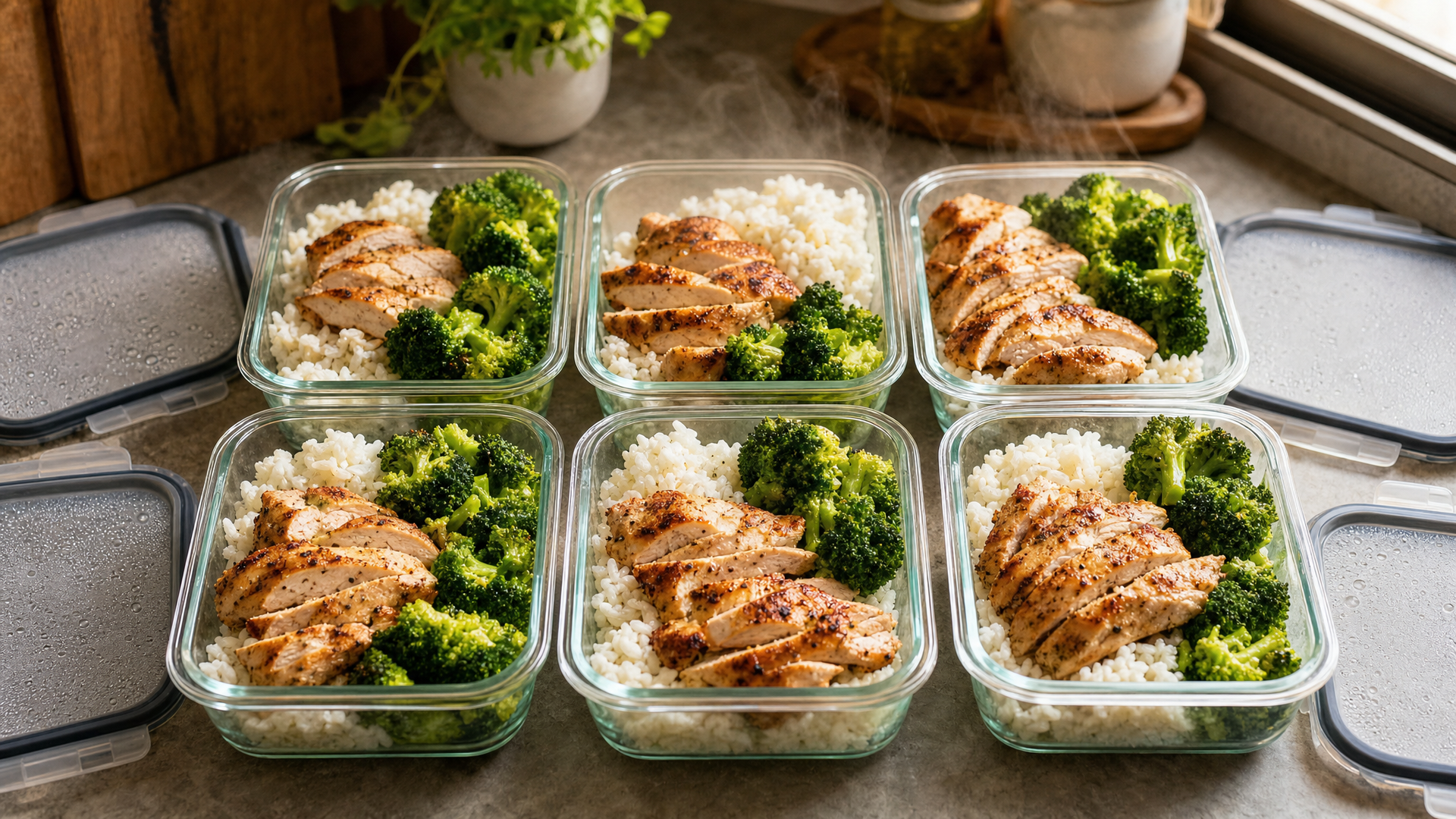
You did everything right on Sunday. Three hours in the kitchen, 6 lbs of rice, a tray of chicken thighs, containers stacked five high in the fridge like ammunition.
Then it's Thursday night. You pull out container number nine. It smells… fine? Probably fine. You microwave it an extra minute, "just to be safe," and eat it standing over the sink.
Friday morning you're on the bathroom floor and you don't eat properly for three days.
Here's the part nobody in the bulking world talks about: getting sick isn't just unpleasant when you're trying to gain weight. It's a direct hit to the only thing that matters — total calories over time. Three days of eating nothing but crackers and flat soda can erase two to three weeks of a careful surplus. You don't just lose the weight you gained. You lose the momentum, the appetite adaptation, and usually a chunk of your motivation too.
So let's fix it properly. Not with vague "eat it within a few days" advice, but with actual windows, per food, and the handful of rules that make a 7-day prep genuinely safe instead of a slow-motion coin flip.
- Cooked food gets 3-4 days in the fridge — 5 is the absolute ceiling for most things, not the target
- Cooked rice is the single riskiest thing in your fridge because of Bacillus cereus toxins
- You have 2 hours to get hot food into the fridge, and 1 hour if your kitchen is warm
- Reheating kills bacteria but does NOT destroy the toxins they already made
- Shallow containers cool food 3-4x faster than deep ones — this is the whole game
- Freeze half your prep on day 0 or day 3, and a 7-day batch becomes completely safe
- The smell test misses the two organisms most likely to actually put you down
Why food safety hits bulkers harder than anyone else
If you're a naturally skinny guy trying to get to 175 lb from 155 lb, you already know your appetite is the bottleneck. You're forcing down 3,200-3,800 calories a day. You've built a system. It's fragile.
Now add food poisoning. A moderate case of Bacillus cereus or Staph aureus food poisoning means 12-24 hours of vomiting, then two or three days where the thought of chicken and rice makes you gag. Realistically:
- Day 1: maybe 500 calories
- Day 2: maybe 1,200
- Day 3: maybe 2,000
- Days 4-6: appetite still suppressed, call it 2,500
That's roughly a 6,000-calorie deficit against your normal intake, spread over a week where you also skipped the gym. At a healthy gaining rate of 0.5-1 lb per week, you just deleted two to four weeks of work in a single bad container.
And there's a second-order cost. Getting wrecked once makes guys paranoid — they start binning food at day 3, cooking every night, and eventually abandoning meal prep entirely. That's how a food safety problem quietly becomes a "can't hit my calories" problem.
One bad container costs more than a whole month of buying slightly better containers, a fridge thermometer, and freezer bags. This is the cheapest insurance in the entire bulking game.
The two hours that decide everything
Almost every meal prep horror story starts in the same place: hot food sitting on the counter.
Bacteria multiply fastest between roughly 40°F and 140°F (4°C and 60°C). That's the danger zone, and it's not a gentle gradient — in the middle of that range, some bacteria double every 20 minutes. Ten of them become over a million in under seven hours.
The rule is simple: cooked food goes into the fridge within 2 hours of coming off the heat. If your kitchen is above 90°F (32°C) — summer, no AC, oven's been running for two hours — that window drops to 1 hour.
Here's where nearly everyone screws it up. You cook 3 lbs of rice, dump it in a big container, and put it in the fridge after 45 minutes feeling responsible. But a deep mass of hot rice is basically a thermal battery. The center of that container can stay above 40°F (4°C) for five or six hours — it doesn't matter that it went in the fridge at minute 45. The middle of it sat in the danger zone half the night.
Shallow containers fix this completely
Spread the same rice across three containers at 2 inches deep or less and the center hits fridge temperature in under an hour. That's it. That's the fix.
Other things that speed cooling, in rough order of usefulness:
- Spread it thin on a sheet pan for 10-15 minutes before portioning
- Don't stack containers while they're still warm — leave air gaps for the first hour
- Lid off or cracked until it stops steaming, then seal
- Break up big masses — cut a whole chicken breast in half, split the ground beef
Never cool a big pot of chili, curry or soup by leaving the whole pot out overnight. A deep pot can stay in the danger zone for eight-plus hours even in a cool kitchen. Portion it hot into shallow containers instead.
The "don't put hot food in the fridge, it'll warm everything up" thing is mostly a myth for normal portion sizes. A modern fridge handles a few shallow containers fine. What actually warms your fridge is a giant sealed pot of hot stew — which is exactly the thing you shouldn't be doing anyway.
The actual fridge timeline, food by food
Assume your fridge runs at 40°F (4°C) or below. If you've never checked, buy a $5 fridge thermometer — a surprising number of fridges sit at 45-48°F (7-9°C), which quietly halves every number below.
| Food | Fridge (safe) | Freezer (quality) | Notes |
|---|---|---|---|
| Cooked rice | 3-4 days | 3 months | Highest-risk item. Cool fast, no exceptions |
| Cooked chicken / turkey | 3-4 days | 4 months | Dries out by day 4; sauce it |
| Cooked ground beef | 3-4 days | 3 months | Fine reheated from frozen |
| Cooked steak / whole cuts | 3-4 days | 4 months | Slice before freezing |
| Cooked fish | 2-3 days | 2 months | Shortest window of any protein |
| Hard-boiled eggs (in shell) | 7 days | Don't freeze | Peeled: 3-4 days |
| Scrambled / cooked eggs | 3-4 days | 2 months | Reheat gently or they turn to rubber |
| Cooked pasta / potatoes | 3-5 days | 2 months | Same cooling rules as rice |
| Cooked beans / lentils | 4-5 days | 3 months | Freeze in portions with liquid |
| Overnight oats | 4-5 days | Don't bother | Texture degrades after day 3 |
| Protein shake (milk-based) | 24-48 hours | 1 month | Keep cold the whole time |
| Cut fruit (melon, berries) | 2-3 days | 6 months | Freeze for shakes instead of binning |
| Cooked veg (broccoli, etc.) | 3-5 days | 8 months | Roasted keeps better than steamed |
| Chili / curry / stew | 3-4 days | 3 months | Shallow containers or don't bother |
| Gravy / meat-based sauces | 1-2 days | 3 months | Genuinely short — respect it |
Two things jump out of that table.
First, almost nothing cooked gets more than 4 days. The classic "prep on Sunday, eat until Friday" plan is already over the line by Thursday dinner, and well past it by Friday.
Second, freezer numbers are about quality, not safety. Food held at 0°F (-18°C) is safe basically forever — it just gets progressively less pleasant to eat. A chicken breast at six months won't hurt you. It'll just taste like the inside of a freezer.
Rice: the one that actually puts people in bed
If you take one thing from this article, take this.
Cooked rice is the single most common cause of "I meal prepped and got destroyed." The organism is Bacillus cereus, and it's a genuinely nasty piece of engineering.
Here's the problem. B. cereus lives on uncooked rice as heat-resistant spores. Boiling your rice doesn't kill them — the spores survive comfortably. When the cooked rice cools down into the danger zone and stays there, those spores wake up, multiply, and start producing a toxin called cereulide.
And cereulide is heat-stable. You can boil it. You can microwave it for three minutes. You can fry it in a screaming-hot wok. The toxin does not care. That's why "fried rice syndrome" is a real named phenomenon in food safety literature — the classic case is rice left out overnight, fried the next day, and eaten by someone who did everything except the one thing that mattered.
Symptoms hit fast — typically 30 minutes to 6 hours — and it's usually violent vomiting rather than the slow-burn stomach upset you'd get from something else.
Reheating food kills live bacteria. It does not destroy toxins those bacteria already produced. If food has been mishandled, no amount of heat makes it safe again. This is the single most misunderstood idea in home food safety.
Rice rules that actually work
- Get it out of the pot and into shallow containers within 30 minutes of cooking, not two hours
- Spread it on a sheet pan if you cooked a big batch — it drops temperature dramatically faster
- Never leave rice in a rice cooker on "keep warm" overnight. Keep-warm settings often sit around 140-150°F (60-65°C), which is borderline
- Eat within 3-4 days, or freeze it — rice freezes and reheats better than almost any other carb
- Reheat until steaming hot all the way through, and only reheat a portion once
Frozen cooked rice reheated with a splash of water is genuinely indistinguishable from fresh. If you're prepping a full week, freezing half your rice on day 0 costs you nothing and removes the biggest risk in your fridge.
Chicken, beef, fish and eggs
Chicken gets 3-4 days, and the practical limit is usually taste, not safety. Cooked chicken breast at day 4 is dry, stringy and a chore to eat — which matters, because a meal you don't want to eat is calories you don't consume. Cook it in sauce, use thighs instead of breast, or freeze days 5-7 on prep day.
Ground beef is 3-4 days too, and it holds up better than chicken because the fat keeps it palatable. Ground meat has more surface area exposed to bacteria than a whole cut, so it's worth being strict about cooling it fast — spread 2 lbs of cooked mince thin rather than leaving it mounded in the pan.
Fish is the short one: 2-3 days maximum. A 5 oz salmon fillet cooked Sunday should be gone by Tuesday. This isn't fussiness — fish spoils faster because of its enzyme profile and softer muscle structure.
Eggs are the pleasant surprise. Hard-boiled eggs still in the shell keep for a full 7 days, which makes them one of the best true week-long prep foods for a bulk. Peel them and that drops to 3-4 days, because you've removed the protective barrier. Peel as you eat.
Cooked potatoes deserve a specific warning: potatoes left at room temperature in foil are a known botulism risk, because the foil creates a low-oxygen environment. Cook them, cool them uncovered, then refrigerate.
If day 4 chicken keeps ending up in the bin, you don't have a food safety problem — you have a variety problem. Rotating your protein and carb sources also happens to be one of the easiest ways to keep your digestion from falling apart mid-bulk.
Shakes, oats and the liquid calories problem
Shakes are where bulkers get sloppy, because a shake doesn't feel like "food."
A milk-and-whey shake is a nutrient-dense liquid sitting at the perfect pH and temperature for bacteria. Blended Sunday night, kept properly cold, it's good for 24-48 hours. That's it. And "properly cold" means the fridge, not your gym bag, not your car, not your desk from 8am to 4pm.
A shake that sits at room temperature for more than 2 hours should be poured out. I know it has 900 calories in it. Pour it out.
Practical fixes:
- Pre-portion the dry ingredients — oats, protein powder, milk powder — into jars or bags, and add liquid right before drinking
- Freeze your fruit instead of refrigerating it. 7 oz of frozen banana blends into a thicker, colder shake anyway
- Use an insulated bottle if the shake has to travel, and treat 4 hours as the outer limit even then
- Blend fresh in the morning if you're adding 2 oz of peanut butter and whole milk — it takes 90 seconds
Overnight oats are more forgiving: 4-5 days is fine, though the texture goes gluey around day 3. Making them in two batches — Sunday and Wednesday — takes four extra minutes total and makes the back half of the week noticeably better.
The smell test is a liar
Here's the uncomfortable truth: your nose detects spoilage organisms, not pathogens.
The bacteria that make food smell bad, go slimy, and turn grey are mostly harmless. They're just unpleasant. Meanwhile the organisms that will genuinely wreck you — Salmonella, Listeria, Staph aureus, B. cereus — often produce no smell, no taste, and no visible change at all.
That's the whole trap. The food that looks and smells fine on day six is exactly the food people eat, because their senses give them the all-clear.
So the smell test works in one direction only:
- Smells bad → throw it out. Always. No debate.
- Smells fine → tells you nothing. Go by the calendar.
Which means you need dates on containers. A strip of masking tape and a Sharpie, or just a note in your phone: "chicken + rice, cooked Sunday." Takes eight seconds and removes every "wait, was this Monday or Tuesday?" moment from your week.
Mold on soft or cooked foods isn't a "cut around it" situation — the visible fuzz is a fraction of a root network running through the whole thing, and some molds produce toxins. Hard cheese and firm vegetables are the exceptions. Cooked meal prep isn't.
How to make a 7-day prep actually legal
You want to cook once a week. The fridge gives you four days. These aren't compatible — unless you use the freezer, which is the part most people skip because it feels like extra work.
It isn't. Here's the whole system.
The day-0 split
On prep day, portion everything as normal. Then take the containers for days 5, 6 and 7 and put them straight in the freezer while they're still fresh, before they've spent a single day in the fridge.
Thursday night, move Friday's container to the fridge. It thaws overnight and you eat it Friday like it was cooked that morning — because functionally, it was.
This is strictly better than the alternative. Food frozen on day 0 has zero bacterial history. Food frozen on day 4 was already at the edge of its window and the freezer just paused it there.
The day-3 rescue
If you didn't plan ahead and it's Wednesday with four containers left, freeze them now, not Friday. Freezing stops the clock — it doesn't rewind it. Something frozen on day 3 comes out of the freezer as day 3 food, and you should eat it within a day or two of thawing.
Thawing rules
- Fridge thawing is the only method that keeps food out of the danger zone. Plan 12-24 hours.
- Never thaw on the counter. The outside hits room temperature hours before the middle thaws.
- Reheat straight from frozen if you forgot — microwave on 50% power, stir, then finish on full.
- Don't refreeze food you thawed and left sitting out. Fridge-thawed and still cold is fine to refreeze once, at a quality cost.
If you want to go further and build the freezer half of your prep on purpose rather than as an afterthought, this list of freezer meals built for gaining weight is the natural next step — most of them are designed to go from freezer to plate without a thaw.
A prep-day schedule that keeps the clock on your side
The point of this schedule is that nothing hot sits around. Cooking is staggered so things finish in waves and get cooled immediately, instead of everything landing on the counter at once.
For a guy at 5'10" eating around 3,400 calories, this covers roughly 5-6 lbs of cooked food.
0:00 — Start the slow stuff. Oven to 400°F (200°C). 3 lbs of chicken thighs and two trays of vegetables in. Rice on. Eggs on to boil.
0:20 — Eggs out. Ice bath, then straight into the fridge in the shell. Done for the week.
0:25 — Rice done. Immediately spread it on a sheet pan, thin. Do not leave it in the pot. This is the highest-leverage 30 seconds of the entire session.
0:30 — Ground beef. Brown 2 lbs in a wide pan, spread thin when done so it cools fast.
0:40 — Rice into containers. It's already near room temperature. Portion at 7 oz cooked per container and get them into the fridge with gaps between them.
0:50 — Chicken and veg out. Rest 5 minutes, then slice — sliced meat cools far faster than whole pieces.
1:05 — Assemble. Build containers, roughly 6 oz of cooked protein each to land near 0.9 g per lb of bodyweight across the day.
1:15 — Split and label. Days 1-4 to the fridge. Days 5-7 to the freezer, right now. Date every lid.
1:20 — Done. Everything cooked was in the fridge or freezer inside 90 minutes of leaving the heat. Not one item came close to the 2-hour limit.
If the sequencing side of prep is still new to you, the complete beginner's guide to meal prep for muscle gain covers portioning and grocery planning in much more depth — this article is the safety layer that sits on top of it.
Keep a permanent marker taped to the side of your fridge. The friction of finding a pen is the actual reason people stop labelling containers after week two.
Five mistakes that cost people a week of gains
- Cooling in the cooking pot. A deep pot is a heat trap. Portion hot, cool shallow.
- Stacking warm containers immediately. The middle one in a stack of five can take four hours to cool. Give them space for the first hour.
- Treating the freezer as day-4 storage. Freeze fresh, not tired.
- Reheating the same container twice. Every reheat-and-cool cycle passes back through the danger zone. Take out what you'll eat, once.
- Running the fridge too warm. Above 40°F (4°C), every number in this article gets shorter. Check it.
Where FuelTheGains fits
The reason food safety matters so much for skinny guys is that a bulk is really just an adherence problem wearing a nutrition costume. You know roughly what to eat. The hard part is eating it, every day, for months, without your system breaking.
That's the gap is built for. It gives you a weekly plan that already accounts for how food actually behaves — protein sources rotated so day 4 doesn't taste like punishment, batch sizes that fit a normal fridge, and a clear split between what to eat fresh and what to freeze on prep day. You get a grocery list that matches the plan, so you're not standing in the kitchen with 4 lbs of chicken and no plan for half of it.
It won't cook for you. But it removes the two things that quietly kill most bulks: not knowing what to prep, and prepping more than you can safely eat.
The bottom line
Four days in the fridge. Two hours to get it cold. Shallow containers. Freeze the back half of the week on day one, not day four. Label everything, and stop trusting your nose.
That's the entire system, and it takes about ten extra minutes per prep session.
You're already doing the hard part — the shopping, the cooking, the forcing down of meals when you're not hungry. Don't let a container of Thursday rice undo three weeks of it.