
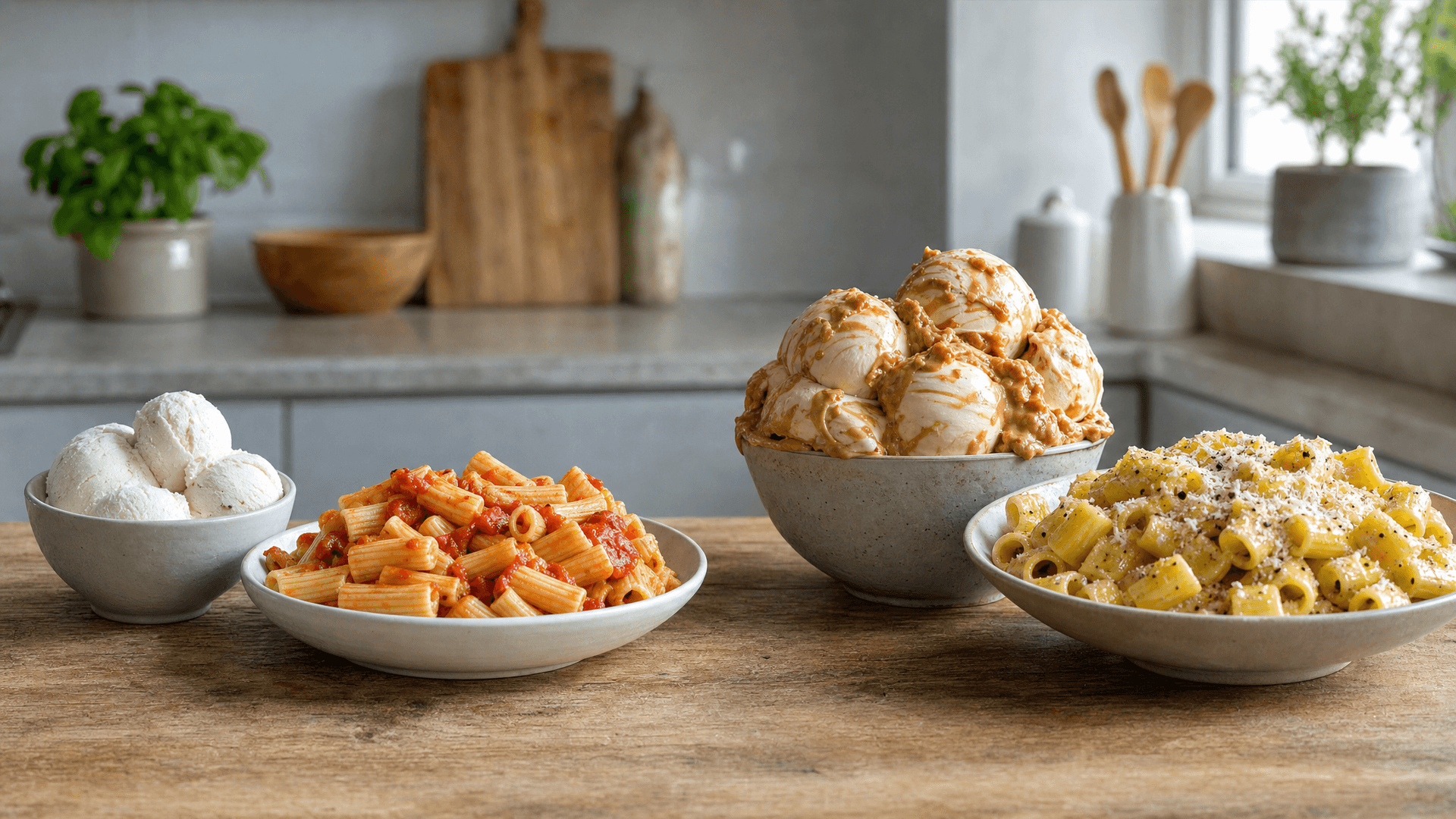
You did everything right. You walked into the store, ignored the candy aisle, and filled your cart with things that had "PROTEIN" stamped on the front in big block letters. Protein ice cream. Protein pasta. Protein chips. Zero-sugar syrup. Light Greek yogurt.
Then you stepped on the scale three weeks later and hadn't gained a damn pound.
Here's what nobody told you: almost every product with "protein" on the label was designed for someone trying to lose weight. Not you. The entire product category exists because someone in a marketing meeting realized people will pay double for a food that lets them eat a familiar treat with fewer calories.
That's a great business. It's a terrible bulking strategy.
If you're a hardgainer eating 3,200 calories a day, swapping the normal version of six foods for the "protein" version can quietly erase 600-900 calories a day. That's not a small leak. That's your entire surplus, gone, while you're doing everything you think you should be doing.
- Protein-branded foods are engineered for dieters — they remove calories and add fiber, water and sweeteners
- Protein ice cream costs you 400-500 calories versus the real thing for about 20g of extra protein
- Light yogurt, zero-sugar syrups and protein chips are the worst offenders per dollar spent
- Protein pasta adds fiber that fills you up and makes the next meal harder
- The keepers: whey, cottage cheese, full-fat Greek yogurt, protein granola and real jerky
- Read the calories-per-serving line before the protein line — that's the number that decides your bulk
Why "High Protein" Almost Always Means "Low Calorie"
Food companies don't make protein products for lifters. They make them for the much, much larger market of people who want to feel virtuous about dessert.
To make a "high-protein" version of anything, manufacturers do the same three things every time:
- Strip the fat. Fat is 9 calories per gram — the fastest lever to pull. Full-fat yogurt becomes 0%. Ice cream cream becomes skim milk and air.
- Replace sugar with sweeteners and fiber. Erythritol, allulose, chicory root fiber. These add sweetness and bulk with almost no usable calories.
- Add whey or milk protein isolate. Usually 10-20g per serving, which sounds impressive on the front of the box.
The net result is a food with a beautiful protein-to-calorie ratio. Dieters love it. If you're a hardgainer, that ratio is exactly backwards from what you need.
You don't have a protein problem. You have a calorie problem. Most skinny guys I've talked to are already hitting 0.7-1.0g per lb of bodyweight in protein without trying that hard. What they're missing is 500 calories a day of easy, dense energy. And every protein-branded swap makes that harder, not easier.
For cutting, you want high protein per calorie. For bulking, you want high calories per unit of fullness. These are opposite goals, and almost every product in the "protein" aisle is optimized for the first one.
The Worst Offenders (With the Actual Math)
Let's go through the big ones. Each of these is a swap a lot of guys make without thinking twice.
1. Protein Ice Cream
This is the king of bulk sabotage. A full pint of protein ice cream runs about 280-400 calories with 20g protein. A pint of regular full-fat ice cream? 900-1,100 calories.
| Product (1 pint) | Calories | Protein | Fat |
|---|---|---|---|
| Protein ice cream | 320 | 20g | 8g |
| Regular ice cream | 1,000 | 16g | 56g |
| Premium/gelato style | 1,200 | 20g | 72g |
You gained 4g of protein and lost 680 calories. For a guy eating four to five times a week, that's a 3,000-calorie hole in your month.
And here's the worst part: protein ice cream isn't even satisfying. The texture is icy, the sweetness is artificial, and you finish the pint still wanting dessert. So you eat something else. Except now you've spent $6 and your appetite on a food that did nothing for you.
Sugar alcohols in protein ice cream — erythritol, maltitol, sorbitol — cause bloating and gas in a lot of people at high doses. Bloating kills appetite. Killing appetite when you're trying to eat 3,500 calories is the single most expensive thing a food can do to you.
2. Protein Pasta (Chickpea, Lentil, Edamame)
This one feels smart. "It's pasta, but with 25g of protein!" And it's true, the protein is real.
But look at what happens across a full meal. A 3.5 oz dry serving of regular semolina pasta is about 360 calories with 3g fiber. The same weight of chickpea pasta is 340 calories with 13g fiber.
Similar calories. Four times the fiber. That fiber sits in your gut, absorbs water, and makes you feel like you swallowed a brick. Most guys who switch end up eating less pasta by volume because they physically can't finish the bowl.
Then, two hours later when you're supposed to be eating your next meal, you're still full. That's the real cost — not the 20 calories on the label, but the meal you skip downstream.
If you want pasta with more protein, don't change the pasta. Change what goes on it. An extra 4 oz of ground beef in the sauce adds 30g protein and 300 calories with zero added fiber.
3. Light / 0% Greek Yogurt
Yogurt is where the biggest silent losses happen, because most guys eat it daily.
| Yogurt type | Calories | Protein | Fat |
|---|---|---|---|
| 0% Greek, plain | 120 | 20g | 0g |
| 5% Greek, plain | 190 | 18g | 9g |
| 10% Greek, plain | 250 | 16g | 17g |
| Skyr, flavored "light" | 110 | 18g | 0g |
Each row above is a standard 6 oz single-serve container. If you eat two a day and you're buying the 0% version, you're leaving 260 calories a day on the table versus the 10%. Over a month that's roughly 7,800 calories — call it 2 lb of bodyweight you didn't gain.
The full-fat version also tastes better, keeps you satisfied without feeling stuffed, and doesn't need the sweetener load that light versions use to compensate for the missing fat.
4. Zero-Sugar Syrups, Jams and Sauces
These are pure calorie deletion with nothing gained.
- Regular maple syrup, 2 tbsp: 210 calories
- Zero-sugar syrup, 2 tbsp: 20 calories
- Regular jam, 2 tbsp: 110 calories
- Zero-sugar jam, 2 tbsp: 20 calories
- Regular BBQ sauce, 2 tbsp: 70 calories
- Zero-sugar BBQ sauce, 2 tbsp: 15 calories
If your breakfast and dinner both involve a sauce or syrup, that's easily 250 calories a day deleted for literally zero benefit to you. You don't need to control your sugar intake. You need calories that go down without making you feel full, and liquid sugar is one of the best tools available for that.
This is the same logic behind high-calorie foods that don't fill you up — the stuff that adds energy without adding volume is exactly what a hardgainer should be reaching for.
5. Protein Chips and Protein Puffs
A bag of protein chips: 130 calories, 15g protein, and the texture of styrofoam. A bag of real chips: 320 calories, 3g protein, and you actually enjoy eating them.
Snacks are the easiest place to add calories to your day because you eat them on autopilot between meals. Swapping every snack to a protein version turns your best calorie opportunity into your worst. If you want to see what a snack should look like when you're bulking, look at our list of bulking snacks that are actually high calorie.
6. Protein Bars Marketed as "Low Sugar"
There are two completely different products sharing the same shelf.
| Bar type | Calories | Protein | Use case |
|---|---|---|---|
| Low-sugar diet bar | 190 | 20g | Cutting |
| Meal-replacement bar | 380 | 20g | Bulking |
| Oat/nut-based bar | 340 | 12g | Bulking |
The first one is a snack designed to be eaten instead of food. The second and third are designed to be eaten in addition to it. Same shelf, opposite purposes. Flip the bar over and check the calorie line — if it's under 250, it's a diet product.
7. Cauliflower / Lentil / "Better-For-You" Everything
Cauliflower rice, cauliflower pizza crust, lentil chips, egg-white wraps, shirataki noodles. Anything that replaces a starch with a vegetable is a calorie deletion tool. A cup of white rice is 205 calories. A cup of cauliflower rice is 25 calories.
That's a 180-calorie deletion from a single side dish. Do it at two meals and you've removed almost a pound of monthly weight gain from your diet without noticing.
Egg-white-only products deserve a special mention. The yolk holds most of the calories, the fat, the choline and half the flavor. Eating egg whites while trying to gain weight is like removing the engine from a car and wondering why it's slow.
The Real Cost: A Day in the Life
Let's make this concrete. Here's a guy at 155 lb trying to eat 3,300 calories a day. He shops "clean and high protein." Here's his day versus the same day with normal foods.
| Meal | Protein version | Normal version | Lost |
|---|---|---|---|
| Breakfast yogurt bowl | 240 | 470 | 230 |
| Lunch wrap (egg white, light sauce) | 380 | 620 | 240 |
| Afternoon protein bar | 190 | 380 | 190 |
| Dinner pasta + zero-sugar sauce | 610 | 780 | 170 |
| Evening protein ice cream | 320 | 700 | 380 |
| Total | 1,740 | 2,950 | 1,210 |
Twelve hundred calories. Same number of meals. Same eating effort. Same shopping trip. The only difference is which version of each product went into the cart.
He thinks he's eating a lot. His stomach agrees — all that fiber and water and air fills him up. But the scale doesn't care how full you feel. It cares about energy, and he deleted a third of his.
If you've been "eating a ton" and not gaining, don't add another meal first. Audit the meals you already eat and upgrade each one to its full-fat, full-sugar version. That's the same calories as adding a sixth meal, with none of the extra effort.
How to Spot a Diet Product in Three Seconds
Forget the front of the package. The front is advertising. Turn it over and run this check:
Step 1: Calories per serving. If a food is meant to be a meal and it's under 400 calories, it's a diet product. If it's a snack and it's under 200, same answer.
Step 2: Fat grams. Anything labeled "light," "lean," "0%," "skinny" or "fit" has had the fat pulled out. Fat is where your calories live.
Step 3: Fiber grams. If a processed food has more than 8g of fiber per serving, someone added chicory root or inulin to bulk it up without calories. Great for dieters. Bad for you.
Step 4: Sugar alcohols. Scroll to the carb breakdown. If erythritol, maltitol or allulose appear, calories were engineered out.
If two or more of these flags show up, put it back. We break down the full label-reading process — serving size tricks, net carb math, all of it — in our guide to reading nutrition labels when bulking.
Divide calories by protein grams. If the number is under 10, the product was built for a cut. Whole milk is around 17. Peanut butter is around 25. Real food for bulking usually lands between 12 and 30.
The High-Protein Products That Actually Earn a Spot
Not everything with protein on the label is a trap. A handful of products genuinely help, because they add protein without subtracting calories.
Whey Protein Powder
Still the best tool in the category. A scoop is 120 calories and 25g protein, and critically, you control what goes with it. Blend it into whole milk with peanut butter and a banana and you've got 700 calories that take 60 seconds to make and go down in two minutes.
The mistake is mixing whey with water. Water adds zero. Use whole milk — that's 1 cup adding 150 calories and 8g protein, every single shake.
Full-Fat Cottage Cheese (4% or higher)
A 8 oz serving of 4% cottage cheese is 220 calories with 25g protein. It's cheap, it's slow-digesting, and it mixes into pasta, eggs, pancakes and sauces without changing the flavor much. Skip the 1% and 2% versions — the fat is the whole point.
10% Greek Yogurt or Full-Fat Skyr
Same food category as the sabotage version above, just not stripped. 7 oz with honey and granola is 550 calories and 20g protein for about ninety seconds of effort.
Protein Granola
One of the rare cases where the "protein" version has more calories than the base version, because they add nuts and seeds to hit the protein number. A 2 oz serving typically lands at 280 calories with 12g protein. Compare labels, but the good brands are legitimately dense.
Real Jerky and Meat Sticks
Not the "97% fat free" jerky — the fatty meat sticks. A single stick is 150 calories and 7g protein with no fiber to fill you up, and it lives in your bag for a week. Great for the 3pm gap when you can't sit down and eat.
Whole Milk and Chocolate Milk
Not marketed as a protein product, which is exactly why it's good. 16 oz of chocolate milk is 400 calories and 16g protein, and it takes ninety seconds to drink. It's the highest calorie-per-effort item in any grocery store.
The pattern in every one of these: the protein comes attached to fat or carbs, not instead of them. That's the whole test. If the protein arrived by removing something, it's a diet food. If it arrived by adding something, it's a bulking food.
The Swap List
Here's the direct replacement chart. Print it, screenshot it, whatever.
| Instead of | Buy this | Calorie gain |
|---|---|---|
| Protein ice cream (pint) | Regular full-fat ice cream | +680 |
| 0% Greek yogurt | 10% Greek yogurt | +130 |
| Zero-sugar syrup | Real maple syrup or honey | +190 |
| Protein chips | Real chips or trail mix | +190 |
| Egg white wrap | Whole eggs + cheese | +240 |
| Cauliflower rice | White rice | +180 |
| Low-sugar protein bar | Meal-replacement bar | +190 |
| Rice cakes | Bagel with cream cheese | +320 |
| Light mayo / light dressing | Full-fat mayo, olive oil | +90 |
| Whey in water | Whey in whole milk | +150 |
Run through that list and change even half of them. That's 700-900 calories a day recovered without adding a single meal or spending an extra minute in the kitchen.
But What About Getting Fat?
Fair question, and worth answering honestly.
You're not going to blow up from eating full-fat yogurt. A lean bulk means eating 300-500 calories above maintenance, and the point of this article is that you're probably not even hitting maintenance right now. The diet products aren't keeping you lean — they're keeping you stuck.
Target roughly 0.5-1 lb of gain per week. If you're gaining faster than 1.5 lb a week for several weeks running, then pull calories back. Until then, more food is the answer.
And if you're genuinely worried about body composition, the lever is training intensity and total protein, not whether your ice cream had 20g of whey in it.
Don't overcorrect into pure junk. The goal isn't "eat garbage" — it's "stop removing calories from good food." Whole milk, real yogurt, olive oil, nuts, rice, pasta, meat with fat still on it. That's not a dirty bulk. That's just food before someone decided to sell you a lighter version of it.
The Three-Week Test
Don't take my word for it. Run this:
- Week 1: Track what you currently eat. Don't change anything. Just log it and get your honest daily average.
- Week 2: Swap every diet-version product in your kitchen for the normal version. Don't add meals. Don't add snacks. Same foods, full-fat editions.
- Week 3: Weigh yourself every morning and take the weekly average.
Most guys see 300-800 calories a day appear out of nowhere and 1-2 lb on the scale by the end of week three. Not from eating more meals — from eating the same meals without the calories engineered out.
If nothing moved, then you have a genuine volume problem and it's time to add a shake. But do the free fix first.
Where FuelTheGains Comes In
The reason this trap catches so many guys is that spotting it requires you to think about every single item in your cart. Which version of the yogurt. Which pasta. Which bar. That's a lot of decisions for something you're supposed to do on autopilot.
That's the problem solves. You put in your stats and your budget, and it builds a meal plan and grocery list where every item is already chosen for calorie density — no light versions, no zero-sugar anything, no accidental cuts hiding in your shopping cart. You just buy what's on the list and cook what's on the plan.
It also tells you the actual numbers for each meal, so when you're wondering whether you're on track, you don't have to guess. The whole point is removing the decision fatigue that makes people default to whatever has the most convincing label.
The Bottom Line
The protein aisle isn't lying to you. Those products really do have protein in them. They're just built for someone with the exact opposite problem to yours.
You're not trying to eat less while feeling full. You're trying to eat more without feeling stuffed. Every "light," "zero-sugar," "high-protein" swap moves you further from that goal while making you feel like you're doing something right.
Go home, open your fridge, and look at how many items have a diet word on the front. Replace them one at a time with the version your grandmother would recognize. Your scale will move within three weeks, and you won't have to eat a single extra meal to make it happen.