
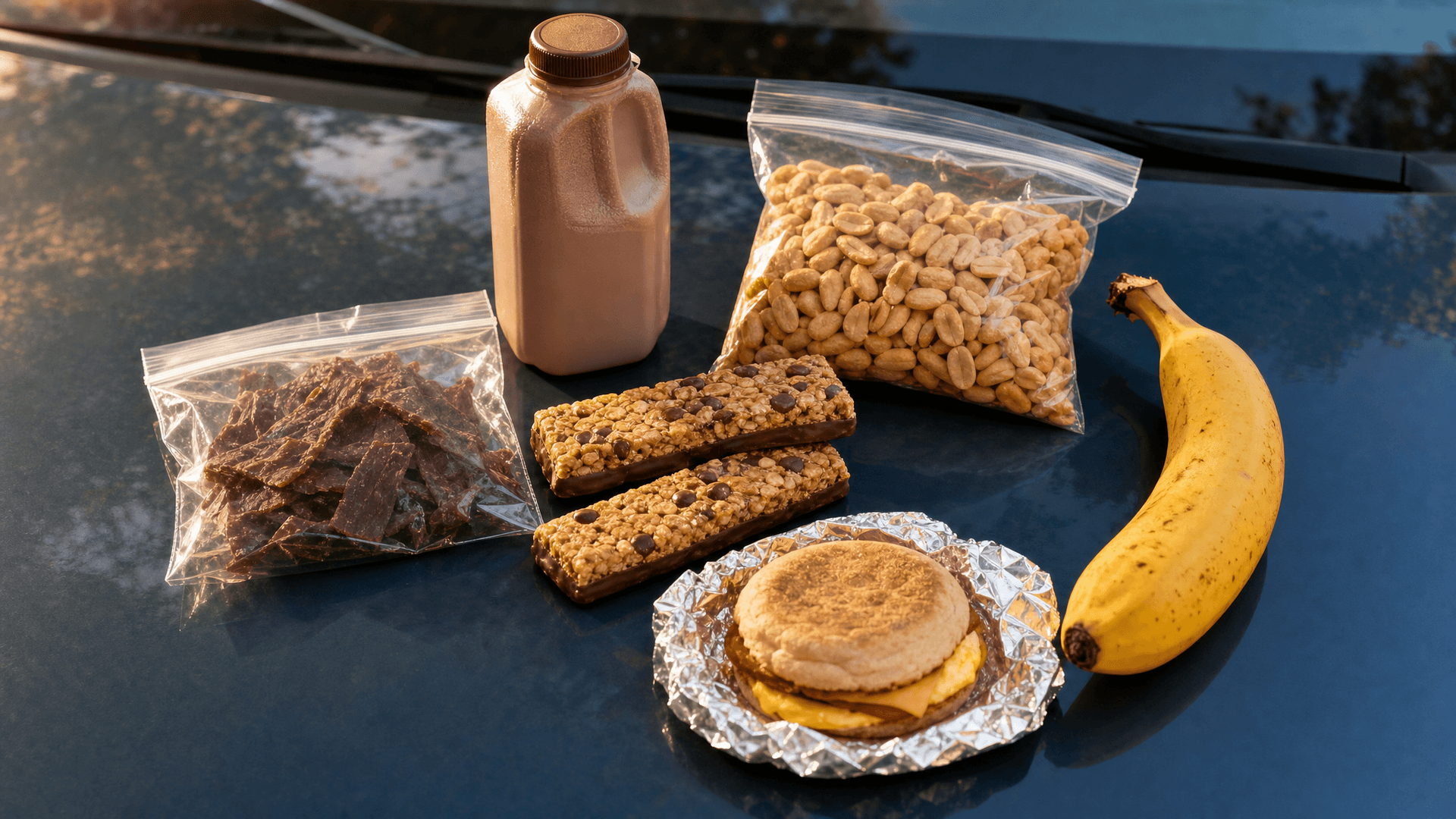
You're three hours into a drive, or your shift just ran ninety minutes long, or you're stuck at an airport with a gate change. Your meal prep is sitting in a fridge you're nowhere near. The only food within reach is a gas station.
For most guys this is where the bulk quietly dies. Not in one dramatic moment — just a missed meal here, a bag of chips and a Diet Coke there. Four skipped meals a month is roughly 3,200 calories you never ate. Do that all year and you've erased something like 3 lbs of the muscle you were trying to build.
Here's the thing nobody tells you: a gas station is actually a decent bulking environment. It's stacked with calorie-dense, shelf-stable, high-fat food. The problem isn't the store — it's that you walk in with a dieter's brain and grab three items that add up to 340 calories.
This is a shelf-by-shelf buying guide. What to grab, in what combinations, at what price, and which "healthy" options are wasting a meal slot you can't afford to waste.
- A gas station stop should hit 700-1,000 calories and 30g+ protein, not 300 calories of chips
- The cooler is your protein section — chocolate milk and dairy do more per dollar than any bar
- Nuts, trail mix and nut butter packets are the calorie engine: fat is 9 calories per gram
- Beef jerky wins on protein density but loses badly on protein per dollar
- Skip anything labeled "light," "veggie," or "baked" — those are meal slots wasted
- Build a default combo once and buy the same three things every time, no decisions needed
Why Gas Stations Wreck Most Bulks
Convenience stores are designed around impulse snacking, not eating. The layout pushes single-serve items sized for someone killing forty minutes in a car, not someone trying to eat 3,500 calories a day.
Three things go wrong.
You default to snack logic. A bag of chips and a soda feels like "food" because it feels indulgent. It's 350 calories and 4g of protein. You've spent five bucks and a meal slot on something that won't hold you for two hours.
You over-correct. Some guys walk in, feel guilty about the environment, and grab a banana and a bottle of water. Now you're at 110 calories. That's not a meal, that's a rounding error.
You buy one thing. This is the biggest one. A gas station meal is never a single item — nothing on those shelves is an 800-calorie unit by itself. You have to stack two or three things, which means you need a plan before you walk in, or you'll grab whatever's at eye level.
If you're a 155 lb guy at 5'11" eating 3,400 calories to gain 0.5-0.9 lb a week, you've got maybe five eating windows a day. Losing one to a bag of pretzels means the other four have to absorb 700 extra calories. That never happens. You just end the day short.
Missing 700 calories once a week is 36,400 calories a year — roughly 10 lbs of bodyweight you never gained. Gas station meals aren't a footnote. They're a category.
The Two-Minute Rule
Here's the framework. Every gas station stop needs three things:
- A liquid calorie base — 300-600 calories you can drink while driving
- A protein anchor — 20-40g from something that isn't a candy bar
- A fat-dense filler — 200-400 calories from nuts, seeds, or nut butter
Hit all three and you're at 700-1,000 calories with 35-50g protein, every single time, in any store in any country. You don't need to read labels. You don't need to think. You grab one item from each category and you're out in under two minutes.
The reason this works is that fat has 9 calories per gram versus 4 for carbs and protein. Gas stations are absolutely full of fat — nuts, cheese, nut butters, full-fat dairy. That's the lever. You're not looking for "healthy," you're looking for calorie density that doesn't fill your stomach.
Same principle we've covered in our breakdown of the best high-calorie bulking snacks — it just applies harder when your options are limited to whatever's on a shelf.
The Cooler: Your Protein Section
Start here. The refrigerated case is where the actual food is, and most guys walk right past it to the chip aisle.
1. Chocolate Milk
The single best item in any convenience store. A 24 oz bottle runs about 450-500 calories with 25-30g of protein, and it's cheap almost everywhere. It's a 3:1 carb-to-protein ratio, which is roughly what sports nutrition research has been recommending for post-training recovery for two decades.
You can drink it in ninety seconds while you're pulling out of the lot. No chewing, no fullness, no cleanup.
Get the whole milk version if it exists. The reduced-fat one costs you 80-100 calories for no benefit.
2. Regular Whole Milk
If chocolate isn't there, plain whole milk still delivers. A 32 oz bottle is about 600 calories and 32g of protein for usually less than three dollars. Pound-for-pound, it's the best protein-per-dollar item in the entire store — better than jerky, better than bars, better than anything at the counter.
3. Greek Yogurt or Skyr
Not every station has it, but more do than you'd expect. A single 6 oz cup gives you 15-20g of protein for 130-180 calories. On its own it's a light snack — pair it with nuts and you've got a real meal.
4. String Cheese or Cheese Sticks
Two or three 1 oz sticks is 240 calories and 21g protein. It travels well, doesn't melt in a hot car for a couple of hours, and it's usually cheap. This is your protein anchor when the milk cooler is picked over.
5. Pre-Made Sandwiches
The much-mocked gas station sandwich is genuinely fine for a bulk. A turkey-and-cheese on a roll is typically 450-550 calories with 25-30g protein. Yes, it's mediocre. You're not eating it for the experience.
Check the cooler before you check anything else. If it has chocolate milk, your protein and half your calories are handled and you only need one more item.
The Snack Aisle: Your Calorie Engine
This is where you find density. The goal here isn't protein — it's getting 300-500 calories into a package small enough to eat in a car.
6. Peanuts
The most underrated item on the shelf. A 3.5 oz bag of salted peanuts is roughly 580 calories with 26g of protein, and it usually costs less than a candy bar. Nothing else in the store touches that calorie-to-dollar ratio.
Honey roasted adds another 30-40 calories per serving. Take it.
7. Cashews or Mixed Nuts
Slightly more expensive, slightly lower in protein, still excellent. A 1.75 oz pack is about 280 calories. Two packs and you've handled your fat-dense filler with room to spare.
8. Trail Mix
The version with chocolate pieces, not the one with dried cranberries and "fruit clusters." A 5 oz bag of nut-and-chocolate trail mix lands around 700 calories. That's an entire meal in one bag.
Watch the ratio though — some trail mixes are 70% raisins and pretzels, which drops the calorie density hard. If you can see mostly nuts through the bag, it's a good one.
9. Nut Butter Squeeze Packets
Peanut or almond butter in a 1.1 oz squeeze pack is about 190 calories of pure convenience. You can eat it straight, squeeze it onto a bagel, or stir it into yogurt. Buy two.
These are also the single easiest thing to keep in a glove box permanently. They don't melt, don't crush, and don't expire for a year.
10. Sunflower Seeds
A 2 oz bag of shelled sunflower seeds is around 340 calories with 12g protein. The in-shell version is a trap — you'll spend twenty minutes and eat 90 calories.
11. Beef Jerky and Meat Sticks
Jerky is the best protein density in the store: a 2.8 oz bag is around 240 calories with 40g of protein. It's also, dollar for dollar, one of the worst deals you'll find anywhere.
Meat sticks are the smarter version of the same idea. A 1.6 oz beef-and-cheese stick is about 180 calories with 12g protein, and it's usually a third of the price of a jerky bag.
Don't build your gas station meal around jerky. It's lean protein, which means it's low calorie and very filling — the exact opposite of what a hardgainer needs. Use it as a supplement, not a base.
The Counter and the Hot Case
12. Donuts, Muffins and Pastries
Say what you want. A 4 oz muffin is 450-550 calories, it costs two dollars, and it goes down in four bites. During a bulk, a "junk" carb-and-fat bomb is a legitimate tool, not a moral failure. It just can't be the whole meal — pair it with a protein source and it's fine.
13. Roller Grill Items
Hot dogs and taquitos get mocked but the numbers are real: a loaded hot dog is 350-400 calories with 15g protein for about three bucks. Two of them plus a milk is a genuine meal.
Use judgment on how long they've been rotating. If you're the first customer in six hours, maybe skip it.
14. Protein Bars
The default choice, and usually the worst value in the store. A 2 oz bar is typically 220-260 calories with 20g protein for four or five dollars — worse calories than peanuts, worse protein per dollar than milk, and priced like a small meal.
They're fine when nothing else works. They shouldn't be your first grab.
15. Full-Fat Coffee Drinks
The bottled latte and frappuccino case is quietly one of the best calorie sources in the store. A large bottled mocha is 300-400 calories with 12-15g protein from the milk base, plus caffeine if you're driving. Cold, fast, and it stacks perfectly with a bag of nuts.
Protein Per Dollar: What Actually Wins
Everyone assumes jerky is the smart protein buy. It isn't — it's the most expensive protein in the building. Here's roughly how the common options stack up.
| Item | Calories | Protein | Approx. price | Protein per dollar |
|---|---|---|---|---|
| Whole milk (large bottle) | 600 | 32g | $2.80 | 11.4g |
| Chocolate milk (large) | 480 | 28g | $3.20 | 8.8g |
| Peanuts (large bag) | 580 | 26g | $3.00 | 8.7g |
| String cheese (3 sticks) | 240 | 21g | $3.00 | 7.0g |
| Meat sticks (2) | 360 | 24g | $4.00 | 6.0g |
| Pre-made sandwich | 500 | 28g | $6.50 | 4.3g |
| Protein bar | 240 | 20g | $4.50 | 4.4g |
| Beef jerky (bag) | 240 | 40g | $9.00 | 4.4g |
Two takeaways. First, dairy wins and it isn't close — milk is more than twice as efficient as jerky. Second, peanuts are the sleeper: near-jerky protein efficiency with more than double the calories.
If you're chasing 0.7-1.0g per lb of bodyweight in protein and doing it on a student budget, the cooler is where your money should go.
Three Combos You Can Build Anywhere
Stop making decisions in the store. Pick one of these, memorize it, and run it every time.
The Standard (about 800 calories, 45g protein)
- Chocolate milk, large bottle
- 3.5 oz bag of peanuts
- One meat stick
Total: roughly 830 calories, 48g protein, about $7. This is the default. It works at literally any store, it takes ninety seconds to assemble, and it's a genuine meal replacement.
The Cheap One (about 900 calories, 42g protein)
- 32 oz whole milk
- Trail mix with chocolate
Total: roughly 1,050 calories, 40g protein, about $6. Two items, best value in the store, and the trail mix keeps for days if you don't finish it.
The No-Cooler Option (about 750 calories, 30g protein)
- Bottled coffee drink
- Two nut butter packets
- A muffin or bagel
Total: roughly 790 calories, 28g protein, about $9. Protein's lower, but when the cooler's been cleaned out this still keeps your day on track.
Buy double. If you're on a long drive, grab two of your combo and eat the second one ninety minutes later. Two stops means two chances to forget.
The Calorie Traps
These are the items that look responsible and quietly cost you a meal.
Baked chips. The whole point of chips for a bulker is fat. Baked versions strip out 40% of the calories and taste worse. Get the regular ones.
Veggie straws and "popped" snacks. A whole bag is 300 calories of air. You'll feel like you ate something and you didn't.
Rice cakes. 35 calories each. You'd need eleven of them to match one muffin.
Light yogurt. 80 calories, 5g protein, artificially sweetened. It's engineered for someone cutting weight.
Diet soda. Zero calories. Fine as a drink alongside food, disastrous as your "meal drink" when you could be having milk.
Fresh fruit alone. A banana is 105 calories. Bananas are great with something. On their own, they're a snack that suppresses your appetite for the next real meal.
Salads with grilled chicken. In a gas station, this is 250 calories and $9. Everything about it is wrong for you.
Anything labeled "protein" that isn't. Protein cookies, protein chips, protein water — most land under 12g of protein at premium prices. Read the panel or skip them.
The unifying rule: if the packaging is bragging about what it took out, it's not for you. You're one of the few people in that store who actively wants the fat, the calories and the full-sugar version.
Mistakes That Turn a Good Stop Into a Wasted One
Only buying one thing. No single gas station item is a meal. If you're leaving with one item, you're leaving with 300 calories.
Eating it too slowly. People sip a milk over two hours and then aren't hungry at dinner. Drink it in one go. Liquid calories work because they clear your stomach fast — that only helps if you actually drink them fast.
Treating it as a cheat meal. This is a logistics problem, not a diet event. Grab the combo, eat it, move on. The guilt spiral where you eat three candy bars because "the day's already ruined" is a much bigger problem than the gas station itself.
Not keeping a glove box stash. Nut butter packets, a bag of nuts and a couple of meat sticks in your car means half your emergency meal is already handled and you only need to buy a drink. Costs about ten dollars, saves you every time.
Only planning for the car. The same principles apply when your no-kitchen problem is a restaurant instead — we've broken that down in the guide to eating out while bulking. Different environment, same job: find the calorie density fast and don't get talked into the light option.
Letting it happen unplanned. If you know you've got a long drive Thursday, you know Thursday needs a gas station meal. That's a scheduled meal, not an emergency. Building that kind of foresight into a packed week is most of the battle — there's more on that in how to bulk on a busy schedule.
Gas station food is salty. A big stop can run 2-3g of sodium easily. If you're tracking, note it and drink water — but for most guys training hard, this is a non-issue, not a reason to skip a meal.
Where FuelTheGains Comes In
The reason gas station meals feel improvised is that most guys don't actually know their numbers. If you don't know whether you need 2,900 or 3,600 calories a day, you can't know whether that stop needs to be 500 calories or 900. So you guess, and guessing under pressure always lands low.
That's the problem solves. It builds a bulking meal plan around your actual bodyweight, training and schedule, so you know exactly what each eating window needs to deliver. When one of those windows gets hijacked by a delayed flight or a client meeting that ran long, you're not improvising — you know you're down 800 calories and you know what to grab to cover it.
It also means the days you are home go further, because you're not silently under-eating and wondering why the scale hasn't moved in three weeks.
The Bottom Line
A gas station isn't a bad place to eat during a bulk. It's a shelf full of calorie-dense fat and cheap dairy protein, and it's open at 2am.
The only thing standing between you and a solid 800-calorie meal is walking in with a plan instead of a vague sense of guilt. Liquid base, protein anchor, fat-dense filler. Three items, two minutes, done.
Pick your combo now, before you need it. The next time your day falls apart, you won't be standing in an aisle deciding — you'll already be back on the road, eating.