
There's a specific kind of pain that only happens after a warehouse store run.
You get home, you unload, and you realize you now own 6 lbs of spinach that will liquefy in nine days, a tub of protein powder in a flavor you don't like, and enough bagels to feed a wedding. You spent $240. You feel like you won. Three weeks later you're throwing out half of it and your cost per calorie is somehow worse than the discount store down the road.
Warehouse stores are genuinely great for bulking. They're just not great at everything, and the gap between the wins and the traps is enormous. Buying bulk oats saves you real money forever. Buying bulk produce as one guy in an apartment is setting fire to $30 on a slow fuse.
This post sorts it out. The 15 items that actually win on cost per 100 calories and cost per 20g of protein, the stuff that rots or goes stale before you can finish it, and the actual break-even math on the membership fee — because if you're only saving $4 a week, that card is a bad investment.
- Warehouse stores win on shelf-stable staples and frozen goods, not on fresh produce or anything single-serve
- The real number to compare is cost per 100 calories and cost per 20g protein, not the sticker price
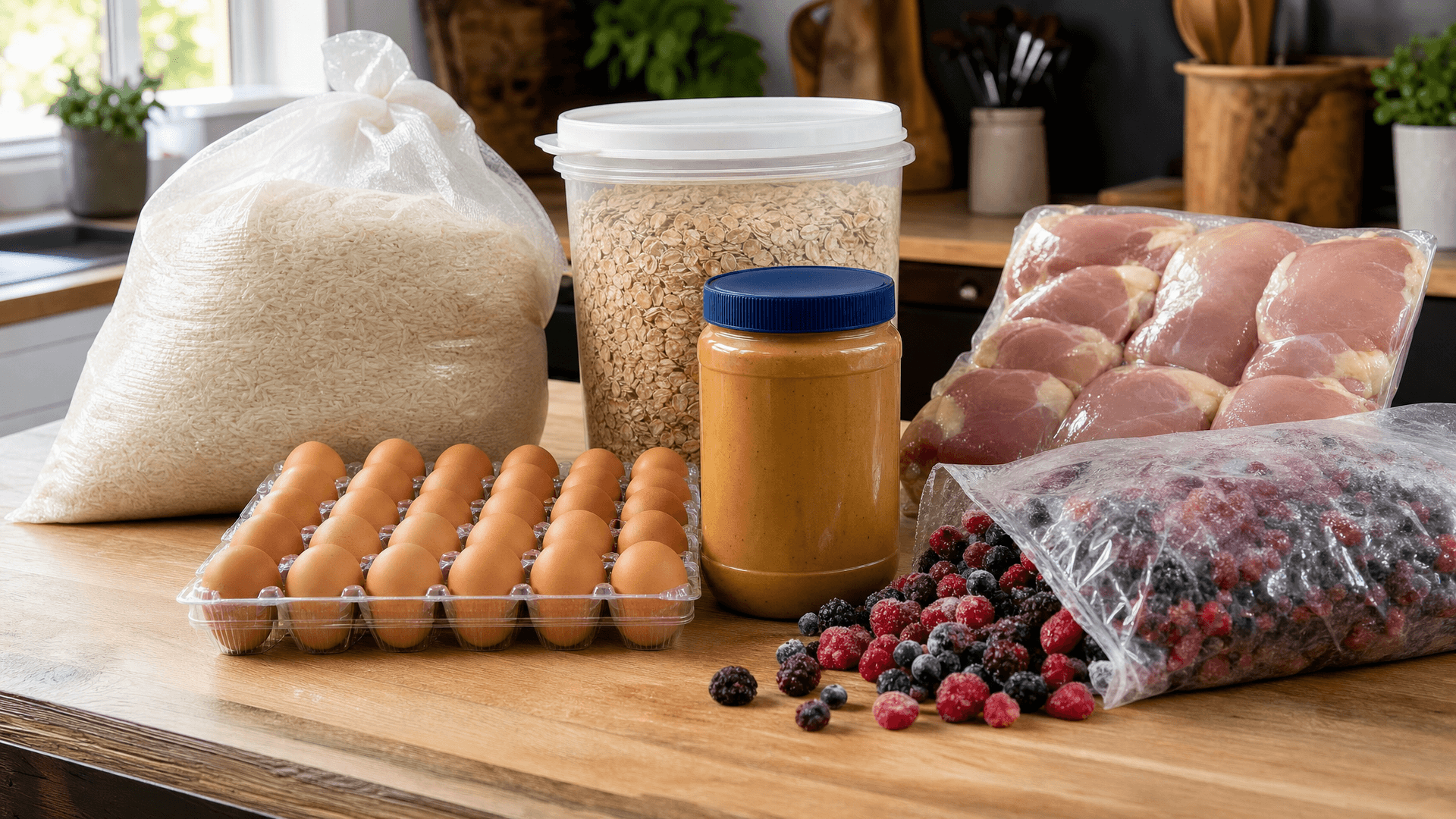
- Oats, rice, whole chickens, eggs, peanut butter and frozen berries are the six items that pay for the trip by themselves
- A basic membership breaks even in 6-9 weeks of real bulking groceries — faster if you're eating 3,500+ calories
- Freezer space is the hard constraint, not money. No freezer, no warehouse strategy
- Split the perishable half of the haul with a training partner or roommate and the math gets stupid good
Why Bulk Buying Works Better for Bulking Than for Anyone Else
Here's the thing most "is Costco worth it" articles miss: they're written for people eating 2,000 calories a day. At that volume, bulk packs genuinely do go bad before you finish them.
You're not that person. If you're bulking, you're eating 3,200 to 4,000 calories a day. You're pushing 5-7 oz of protein daily. A 10 lb bag of rice that takes a normal person four months takes you about five weeks. A 3 lb jar of peanut butter takes six weeks, not a year.
Your consumption rate is the entire reason bulk works for you and doesn't work for your roommate who eats salads. Volume eating turns a storage problem into a savings machine.
The second reason: bulking food is boring on purpose. You eat the same eight or nine things on rotation. Rice, oats, chicken, eggs, ground beef, milk, peanut butter, frozen fruit. That repetition is exactly what bulk buying is built for. You're not gambling on whether you'll want it — you know you'll want it, because you'll eat it Tuesday and again on Thursday.
If you haven't nailed down what that rotation looks like yet, start with our bulking grocery list under $75 a week — it gives you the baseline shopping list this post is optimizing.
How to Actually Compare Prices (The Only Two Numbers That Matter)
Sticker price means nothing. A 4 lb bag of oats costing $6 looks expensive next to a 18 oz canister at $3.50. It's half the price per calorie.
Run everything through two metrics:
Cost per 100 calories — for your energy-dense staples. Rice, oats, pasta, oil, peanut butter. This is your bulking currency. Anything under $0.08 per 100 calories is a strong buy.
Cost per 20g of protein — for your protein sources. Chicken, eggs, beef, dairy, whey. Anything under $0.60 per 20g is good. Under $0.40 is excellent.
Do the division once, write it in your phone's notes app, and you'll never get fooled by a big number on a big package again. We broke down the raw rankings in cheapest calories per dollar for bulking if you want the full food-by-food list.
Most warehouse price tags already show a unit price in tiny print — per ounce, per pound, per count. Photograph the tag, divide by the calories on the nutrition panel, and you've got your number in about 15 seconds.
The 15 Warehouse Buys That Genuinely Win
These are ranked roughly by how much money they save you over a full bulk, not by how exciting they are. Nothing here is exciting. That's the point.
1. Rolled Oats
The undisputed king. A 10 lb bag runs about $11-14 and delivers roughly 17,000 calories. That's $0.07 per 100 calories — and oats come with 5-6g of protein per serving as a bonus.
They keep for a year in a sealed container. There is no version of this that goes wrong.
2. White Rice
A 20 lb bag of jasmine or long grain costs $16-20 and gives you around 33,000 calories. That's $0.05 per 100 calories, the cheapest number on this entire list.
Store it in a sealed bin. It keeps effectively forever. If you're bulking for six months, buy one bag and don't think about carbs again.
3. Whole Chickens (Two-Packs)
Two whole birds at roughly 5 lbs each for around $12-15 total. Once you factor in that you're paying for bone and skin, you're still landing near $0.45 per 20g protein — better than any boneless skinless breast deal you'll find.
Roast both at once. Eat one, shred the other for the week.
4. Rotisserie Chicken
The famous loss-leader. Around $5 for a fully cooked bird yielding 25-32 oz of meat. That's roughly $0.35 per 20g protein, cooked, with zero effort.
Buy two. Strip them the night you get home. Freeze half.
Strip a rotisserie chicken while it's still warm — the meat falls off in about four minutes. Cold, it takes fifteen and you leave a third of it on the carcass.
5. Eggs (Five-Dozen Flats)
Sixty eggs for $11-15 depending on the year and the bird flu situation. Roughly $0.50 per 20g protein, plus 5g of fat each that you need for a calorie surplus anyway.
They last five weeks in the fridge. If you're eating four or five a day, you'll finish the flat in two.
6. Peanut Butter
A 3 lb jar for around $9. That's about $0.09 per 100 calories of pure caloric firepower — 190 calories per tablespoon, and it goes into shakes, oatmeal and sandwiches without you noticing.
If you struggle to hit your surplus, this jar is your single best tool.
7. Frozen Berries
A 4 lb bag for $10-13. Fresh berries at the same store cost more and die in five days. Frozen berries go into shakes, oatmeal and yogurt straight from the bag, and they last nine months.
This is the one produce category where warehouse stores are unambiguously the right call.
8. Frozen Chicken Breast
A 6 lb bag of individually frozen breasts, $22-28. Around $0.55 per 20g protein, and the individual freezing means you thaw exactly what you need instead of committing to 6 lbs of chicken at once.
9. Ground Beef (80/20 or 85/15)
Warehouse packs of 5 lbs at $4-5 per lb. The fat is a feature — 80/20 gives you roughly 280 calories per 4 oz versus 170 for lean.
Split into 1 lb portions in freezer bags the day you buy it. Flatten them so they thaw fast.
10. Canned Tuna and Chicken
Case packs of 12-20 cans. Roughly $0.55 per 20g protein, shelf-stable for three years, and requires zero cooking on the days you're too fried to cook.
11. Olive Oil
A 68 oz bottle for $16-20. At 120 calories per tablespoon, oil is the densest calorie source in your kitchen. Two tablespoons on your rice adds 240 calories you will not feel in your stomach.
12. Whey Protein
A 5 lb tub for $50-65, working out to roughly $0.40 per 20g protein. Compare that to $30 for a 2 lb tub at a supplement shop and you're saving close to 40%.
Buy the flavor you already know you like. A tub this size is 70+ servings — that's a long time with a flavor you hate.
13. Pasta
6 lbs for $7-9. Around $0.06 per 100 calories and stores next to your rice for two years. Rotating pasta in keeps you from hating rice by week five.
14. Cheese Blocks
2 lb blocks for $8-11. Roughly 110 calories and 7g protein per 1 oz. Blocks keep far longer than shredded and don't have the anti-caking starch.
Grate what you need. Add it to everything.
15. Frozen Vegetables
4 lb bags of broccoli, green beans or mixed veg for $8-10. Not a calorie play — this is your fiber and micronutrient insurance so you don't feel like garbage eating 3,800 calories a day.
They don't rot. That's the whole pitch.
The Traps: What Not to Buy in Bulk as One Guy
This is where warehouse shopping goes from smart to expensive. Every item below has burned someone.
| Item | Why it fails | Buy instead |
|---|---|---|
| Fresh spinach / salad greens | Liquefies in 7-9 days, you'll eat 20% | Small bags weekly, or frozen |
| Bananas | Warehouse packs of 6+ lbs, black in 5 days | Grocery store, buy 7 at a time |
| Bread and bagels | Molds in a week unless you freeze it all | Freeze immediately or buy small |
| Deli meat | 10-day window, huge packs | Smaller packs elsewhere |
| Fresh berries | Mold in 4-6 days | Frozen, always |
| Milk (multi-gallon) | 2 weeks max, heavy | Fine if you drink 1 gal/week+ |
| Pre-made salads and wraps | Terrible cost per calorie | Cook |
| Bulk avocados | All ripen on the same day | Grocery store |
| Protein bars (variety packs) | $2+ per bar, poor protein per dollar | Whey + oats |
| Specialty condiments | You use a tablespoon a month | Anywhere else |
The single most common warehouse mistake is buying fresh produce in bulk because it looks cheap per pound. It is cheap per pound. It's brutally expensive per pound you actually eat, which is the only number that counts. Assume you'll waste 40-60% of any bulk fresh produce, then recalculate — it's suddenly the most expensive food in your cart.
The "Half-Finished Tub" Category
There's a second, subtler trap: things you'll finish, eventually, but so slowly that you've tied up cash and shelf space for months. A 4 lb bag of chia seeds. A gallon of coconut oil. A 5 lb bag of a flavored protein you were "going to try."
None of these go bad. They just sit there while your grocery budget is $50 lighter. If you don't use an item at least twice a week, don't buy the warehouse size.
The Membership Break-Even Math
This is the part nobody runs, and it's the whole decision.
A basic warehouse membership runs $60-65 a year. The executive tier is around $130 with 2% cash back. Ignore the executive tier until you know you're spending over $3,000 a year there — below that, the cash back doesn't cover the upgrade.
So: how long until $65 pays for itself?
Here's a realistic weekly bulking haul, priced both ways:
| Item | Warehouse | Regular store | Weekly saving |
|---|---|---|---|
| Oats (weekly share) | $1.80 | $3.20 | $1.40 |
| Rice (weekly share) | $1.20 | $2.40 | $1.20 |
| Eggs (2 dozen) | $5.00 | $7.20 | $2.20 |
| Chicken (weekly share) | $9.50 | $13.00 | $3.50 |
| Ground beef (weekly share) | $9.00 | $11.50 | $2.50 |
| Peanut butter (weekly share) | $1.50 | $2.60 | $1.10 |
| Frozen berries (weekly share) | $3.30 | $5.00 | $1.70 |
| Whey (weekly share) | $5.50 | $8.50 | $3.00 |
| Total weekly saving | $16.60 |
At $16.60 a week, a $65 membership pays for itself in four weeks. Even if you're conservative and assume you only capture half those savings — you forget items, you shop there twice a month, prices shift — you're at eight weeks.
That's the honest answer: if you're bulking properly and you shop there at least twice a month, the card pays for itself inside two months and everything after that is profit. If you're eating 2,200 calories and shopping there four times a year, it doesn't.
Distance. If the warehouse is 25 miles away and the regular store is a five-minute walk, factor in gas and the fact that you'll go less often than you plan to. A membership you use six times a year is a $65 donation.
The Roommate Multiplier
The fastest way to break the math wide open: split the haul.
Two guys bulking together can buy the perishable items — the 5 lb ground beef packs, the two-pack chickens, the multi-gallon milk — and halve them at the register. Every trap item becomes a win, because the volume problem disappears.
Most memberships come with a free household card. Use it. If you're not living with another lifter, a training partner works fine — split the receipt, split the bags in the parking lot, done.
How to Store It So You Don't Waste It
Buying right is half the job. The other half is the two hours after you get home.
Freezer first. Everything that hits the freezer needs to be portioned before it goes in. Ground beef in 1 lb flattened bags. Chicken breasts individually wrapped or in twos. Shredded rotisserie chicken in 7 oz portions. If you freeze a 5 lb block of anything, you will thaw it once, cook all of it, and eat chicken for six straight days until you hate it.
Airtight for dry goods. Oats, rice, pasta and flour go into sealed bins. Not the bag with a clip. Bags let in moisture and pantry moths, and a moth infestation in a 20 lb rice bag is a genuinely miserable afternoon.
Decant peanut butter. Keep a small jar in rotation and refill it from the big one. You'll actually use it instead of wrestling a 3 lb tub every morning.
Label with dates. Sharpie on the freezer bag. Nothing complicated. Frozen meat is good for 6-9 months but "unidentified frozen brick" is good for zero.
Budget 90 minutes for the unpack. Portion, bag, label, store. It's the least fun part of the week and it's the difference between a haul that saves you $70 a month and a haul that fills your freezer with garbage.
Warehouse vs. Discount Grocery: Which Actually Wins?
Honest answer — neither wins outright. They win at different things.
Discount chains like Aldi beat warehouse stores on small-format staples: canned goods, single blocks of cheese, individual produce, bread, store-brand yogurt. Their per-unit prices on those are frequently as good or better, with none of the volume risk and no membership fee.
Warehouse stores beat everything on large-format energy and protein: bulk rice and oats, whole chickens, rotisserie, five-dozen eggs, whey, olive oil, frozen fruit.
The optimal setup for most guys is both. Do a warehouse run every 3-4 weeks for the heavy staples, and top up weekly at a discount store for produce, dairy and whatever you ran out of. We compared the discount tier head-to-head in Aldi vs Walmart for bulking groceries — that comparison is the other half of this strategy.
| Warehouse | Discount chain | |
|---|---|---|
| Best for | Bulk staples, protein, frozen | Produce, small packs, top-ups |
| Membership | $60-65/yr | Free |
| Trip frequency | Every 3-4 weeks | Weekly |
| Storage needed | High | Low |
| Waste risk | High if careless | Low |
A Realistic First Warehouse Haul
If you're walking in for the first time and you want to not screw it up, buy exactly this and nothing else:
- 20 lb white rice
- 10 lb rolled oats
- Five dozen eggs
- Two rotisserie chickens
- 6 lb bag frozen chicken breast
- 5 lb ground beef (split and freeze immediately)
- 3 lb peanut butter
- 4 lb frozen berries
- 4 lb frozen mixed vegetables
- 68 oz olive oil
That's roughly $130-150 and covers 3-4 weeks of bulking carbs, fats and most of your protein. Walk past the produce section. Walk past the snack aisle. Walk past the TVs.
Then top up weekly with milk, bananas, yogurt and fresh vegetables somewhere cheaper.
Common Mistakes
1. Shopping hungry. Universal advice, but warehouse stores weaponize it with free samples and $1.50 hot dogs. Eat first.
2. Buying variety. You're bulking. You need eight foods, not thirty. Variety is what makes bulk buying fail — you can't finish twelve different bulk packs.
3. Ignoring freezer capacity. Measure your freezer before you go. A standard apartment freezer holds maybe 30 lbs of food with other stuff already in it. Buy more than that and something's going in the trash.
4. Falling for "organic" markups. For bulking purposes, conventional rice and conventional oats are nutritionally identical to the organic versions at 40% more.
5. Buying prepared foods. The prepared section has the worst cost per calorie in the building. It's engineered for families who don't want to cook, not for guys trying to hit 3,800 calories on a budget.
6. Not going back. The membership only works if you use it. Set a recurring calendar reminder every three weeks. Treat it like a training session.
Where FuelTheGains Fits In
Here's the thing that bulk buying doesn't solve: knowing what to actually do with 20 lb of rice and five dozen eggs.
You've got the raw materials at the best price you'll find. But turning that into a daily plan that hits your exact surplus — the right calories, the right protein split, meals you'll actually eat twice a week without wanting to quit — is a different problem.
That's what FuelTheGains does. You give it your stats, your surplus target and what's in your kitchen, and it builds the meal plan around the food you already bought. Which means the 6 lb bag of chicken in your freezer becomes seven planned meals instead of a vague intention.
Cheap food plus a plan is how bulks get finished. Cheap food alone is how freezers get full.
The Bottom Line
Warehouse stores cut a bulking grocery bill by 30-40% — but only on shelf-stable staples, frozen goods and large-format protein. On fresh produce and prepared food, they'll cost you more than the discount store once waste is counted.
Buy the fifteen. Skip the traps. Portion everything the day you get home.
Do that and the membership pays for itself in about a month, and every trip after that is $60-70 you didn't have to spend. Over a six-month bulk, that's most of a year's worth of whey protein — for the price of doing your division in the aisle.